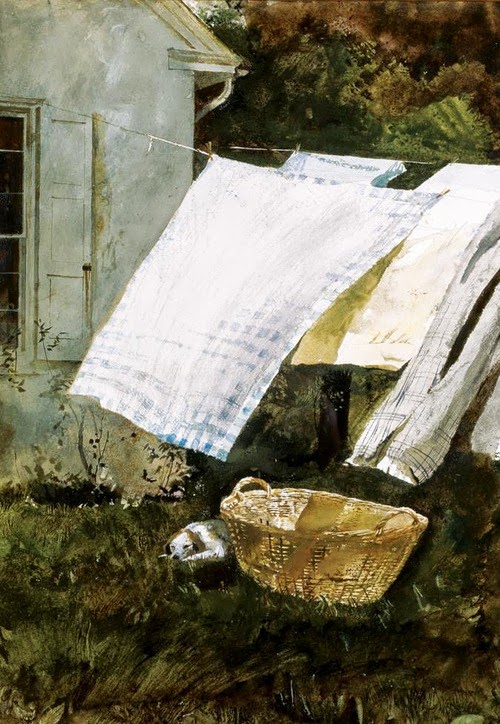
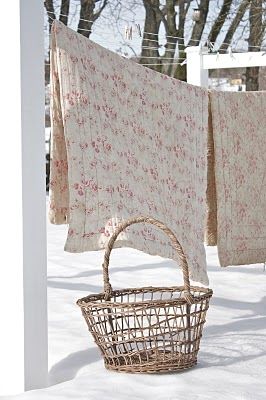
How many of you readers remember the scent of clothes and sheets dried outside in summer? That fragrance is something you never forget. All the fabric softeners in the world can’t duplicate it. In our busy world clothes dryers are something we all use. I can’t imagine hanging clothes out to dry at my stage of life. However, while we are living in London, our flat has a nice washer/dryer combination unit. British machines are very difference from American ones. This one is smaller and takes much, much longer to run a cycle. The dryer often leaves clothes slightly damp. Luckily the flat is well equipped and we have two small folding laundry hangers where I can hang things out to finish drying. I don’t mind doing this at all. It reminds me of my childhood when we always hung laundry outside out of necessity. Even in cold, cold weather.
The following poem was written a few years back for a prompt on PoetsOnline (see http://www.poetsonline.org) about laundry. While several poets chose the metaphorical allusions of hanging one’s laundry out or dirty laundry, the prompt evoked in me a sharp image of having to scramble to pull half-frozen clothing off the line before the snow came.
ON WINTER WASH DAYS
On winter wash days, those on the cusp
of warmth, we hung out the clothes
with numb fingers, feeling the curtain
of clouds closing in.
Those were the days when the sun
often hid, and the cold never left at all.
Fabric froze hard, and dresses
and shirts grew solid and stiff.
Rows of sheets, towels and clothes
waved wildly, like pages of a book
flapping in the wind.
In late afternoon, we took it all down,
clothespins snapping shut as each piece
was pulled, placed in the wicker
basket and taken inside.
The darkness closed in early
those mid-winter days, the
evening star sometimes rising
before the icy moon.
Marcel Proust had his fragrant shell-shaped madeleine and linden flower tea. I have my burnt toast.
How often have you found that a simple smell can carry you back in time or far away? It happens to all of us, the sense of smell being strongly linked to evoking memories. Scientists can now prove this through brain scans, but artists and psychiatrists have long noted how taste and smell work with long-past memories far more than other senses. Proust says it so eloquently:
“When from a long distant past nothing subsists, after the people are dead, after the things are broken and scattered, taste and smell alone, more fragile but enduring, more unsubstantial, more persistent, more faithful, remain poised a long time, like souls, remembering, waiting, hoping, amid the ruins of all the rest; and bear unflinchingly, in the tiny and almost impalpable drop of their essence, the vast structure of recollection.”
For Proust, it wasn’t simply the beautiful shape of the madeleine, but the smell and taste of the madeline dipped in the linden flower tea that brought back a flood of memories.
The other morning as I waited for two eggs to boil, I made some toast. It was lovely whole grain bread bought in a farmer’s market here in London. I cut the slice a bit unevenly, and I think it was this that caused the bread to stay down too long in the toaster. I smelled it before I noticed the smoke. The bread was burnt. Feeling annoyed that I hadn’t caught this in time, I grabbed a knife and began to scrape the charred layer from the toast. You can guess where I am going with this, can’t you? In a split second or two a long forgotten memory came flooding back from my early childhood. The poem, “Burnt Toast” was written later in the week. Interestingly, as I wrote each draft, I imagined the smell of the burnt toast over and over.
Burnt Toast
I burnt the toast.
The butter knife
rasped across
the too dark toast.
Sooty crumbs
flurried down
into the sink,
and the smell
of blackened bread
brought back memories
of momma doing this,
scraping the bad away.
Hazel eyes twinkling,
she’d tell us the burnt part
would whiten our smiles,
and we’d always laugh
at this silly joke,
never quite sure
if it might not be true.
But one lost slice
was one less meal,
and she was unwavering.
We would never
know the hunger
that hovered close by.
Even to this day,
I have a strange fondness
for slightly charred bits of food,
my mother always standing there,
at the edges of my memory.
Since my last posting, my husband and I have flown across the Atlantic and are settling into the faculty flat in Winston House, Bedford Square, London. Quite a beautiful place to live for four months ago. Some of my readers know all about this because they followed my travel blog (Bedford Square + 2), which will continue on a non-Word Press platform. If you are curious, you can find it through this link: http://marykendall2.blogspot.co.uk
We lived here two years ago, spending the spring term and following it with five weeks on the continent. This time ’round we will be here for four months. The flight was, for once, not too bad way back in coach class. The pilot surprised us all by taking off exactly on time and arriving at Heathrow Airport 50 minutes early. For real.
Jet-lag is something that seems to get worse with age, and both of us fell fast asleep at 10 pm on New Year’s Eve. At the stroke of midnight we both woke to what sounded like an awful ruckus. It took only a few seconds to figure out it was the fireworks along the Thames. From our windows we couldn’t see the fireworks directly. What we did see was the sky turning beautiful shades of pink, green, purple, white…and flashes of sparkling white rockets. By sticking my head out the window I figured out that I could see some of the fireworks and those were dazzling enough to me in my exhausted state.
(we didn’t see this from our window, but the sky was quite similar)
After about 12 minutes of this sound and light show in this ancient city, my husband quickly fell back to sleep while I remained wide awake for an hour. It gave me some quiet time to make a cup of tea, sit down in the darkened living area and think about our many visits to the UK and to London in particular.
Our first trip to London and England was back in 1977 when we were young and energetic enough to walk absolutely everywhere. Another summer we spent about a month in London following a month in Oxford where R. did research, and I enjoyed exploring parks, museums, shops, streets. In 1989, we brought the first group of students over on this Honors London program sponsored by my husband’s university. We lived in Hampstead that year, and we loved it. Our son was in nursery school, so I made friends of some spectacular women. The Heath was there for daily walks and our local library was next door to the Keats house. After we checked out our books, my little son and I would go sit in the garden of the Keats House and read stories together. It didn’t ever get better than that for me. Sometimes simple acts or simple gestures are better than anything.
In 2013, we returned to London and were housed in beautiful Winston House that now is home for this London Honors program. It was a very wonderful time for us and for the students. We’ve kept in touch with many of them. And now, in 2015, we are unexpectedly back again for four months. A new group of students will arrive on January 10th, and the term will have begun.
I will continue my travel blog if anyone is interested. Since this blog is devoted to my poetry writing practice, I thought I’d begin the new year with an old poem. I published it in 2013 in my Bedford Square + 2 blog as a Valentine’s gift to my husband. Since his teaching and research have given us both so many wonderful stays in this beautiful country, I’d like to share a very simple love poem I wrote for him. Love is not tied to a single day or week or year, and sometimes simple things like strolling in a beautiful place help you reaffirm your love and relationship.
If you might like to listen to me reading the poem, simply click on the link below. It takes a few seconds to begin.
Taking Your Arm
I took your arm for the first time in so many years. Was it the cold damp air that made me reach out? Was it the need to feel safe in the noisy city streets?
Slipping my fingers into the crook of your arm, the warmth of your soft wool coat was comforting. I felt grounded and balanced by your strength.
Through the busy London streets we walked, much of it in silence, a silence built on knowing that words aren’t always necessary.
I glanced down at our booted feet. Our steps kept time, first left, then right, left, then right, finding the rhythm of these unknown streets.
There are nights in the winter
once the leaves have fallen away,
when sometimes I wake in the dark,
hearing the distant, plaintive sound
of a single train a few miles away
as it crosses over a country road
or maybe it’s to warn off deer
that pause too long on the track.
The train travels due north,
and in the blackness of the night
the train’s dark sounding
brings back fragmented images
of my childhood life up north.
North, where winter’s silver skies
are layered in clouds most
of the year, and where snow
begins to fall early and deep.
North, where my family lived
in the rust belt of Lake Erie,
where strong winds raced across
the lake with bone-chilling cold.
The lake effect meant snowstorms
that went on for hours, even days
on end. Times when all of us gathered
together happily, knowing school
would be cancelled the next day.
Night was peaceful back then.
In the morning, we’d make our
way through the thigh high snow
and help shovel the walk, leaving
tall tunnels of snow on either side.
Our boots would crunch on frozen
snow, fingers painfully cold, but
that never stopped us from a snowball
fight or playing king of the mountain,
or sledding, tumbling, rolling in snow,
or making lovely snow angels
all over the yard. Those were the
carefree days of childhood, when
we didn’t worry about time or the
future or much of anything.
And for a while the thick snow
continued to fall, covering the tracks
of cars, birds and anything else
that dared to wander outside
on those interminable winter days.
Now, no longer in the north,
I lie in bed remembering such
simple times, times of being together
as we coasted down the snow hills,
all six of us tucked in tightly together
until halfway down when the toboggan
shifted and just after the pull to the left,
we capsized, all of us scattered down the hill,
laughter ringing out so loud as we fell,
each of us ready to give it a go again.
Tobagganing in the Snow
My thanks to the photographer, Iosatel, for use of the photograph, Due North, which appeared on his blog, The Obvious and the Hidden, 03/11/2014 on WordPress: http://theobviousandhidden.com/2014/11/03/due-north/




 A Poet in Time