Some Thoughts on Turning to Myth: Looking back at “The First Lamentation of Demeter ~ (Poetry and Myth)”

A Note to My Readers:

Here it is January 2026. My blog has been quiet this year for a number of reasons too long to list.  But the most obvious reason is that of a block or mental ‘resistance’ to writing. Last year in 2024,  I turned to sharing a few older poems of mine that I love. It was a good reminder to me of why I loved writing.

Today, WordPress showed me my latest stats. I rarely look at these anymore, but one thing I notice each time I see an update is that some of the poems I wrote relating to classical myths seem to be accessed the most. I wonder if, in this sad and tumultuous world and country (mine being the USA), we turn to mythology to find answers to timeless questions that appear and reappear over a lifetime. Who are we and why are we here? What is it we are looking for? What really matters? I am now 79.  Those questions and many more have come up time and time again, and the answers have been quite varied over eight decades. What do you, dear reader, think? Why do we cling to myths and tales from long ago and from cultures we know only though history books, literature or art? I’d love to know what you think.

To honor some of these poems, I’m going to post my two Lamentations of Demeter, one at a time. To save some work, I’ll post the whole original poet from my blog. I hope you find some meaning in each of them or perhaps a way to think of something beyond our wild world of today.


 British Museum GR 1885.3-16.1 (Terracotta C 529), AN34724001

British Museum GR 1885.3-16.1 (Terracotta C 529), AN34724001


Here is the original 2014 posting:

.

I’ve been looking over my writing notebooks written a while back but unread by anyone other than myself or my husband. The myths of Demeter and her daughter, Persephone, fascinate many including me. For a number of reasons these myths seem to appeal especially to women. Many of the great living women poets have written brilliant poems about Persephone (e.g., Louise Glück and Eavan Boland). The story is timeless.

.

In today’s poem I’ve written a Lamentation of Demeter. Demeter, the goddess of the harvest and grains, is often referred to as the mother-goddess since she represents fertility on earth. Her importance is indisputable. When she mourns for her missing daughter, Persephone (who has been abducted by Hades and taken down into the underworld by force) the seasons stop. Things stop growing and the earth begins to die before Persephone’s father, Zeus, intervenes.  You know the story, but it is worth re-reading if you haven’t read any mythology for a while.
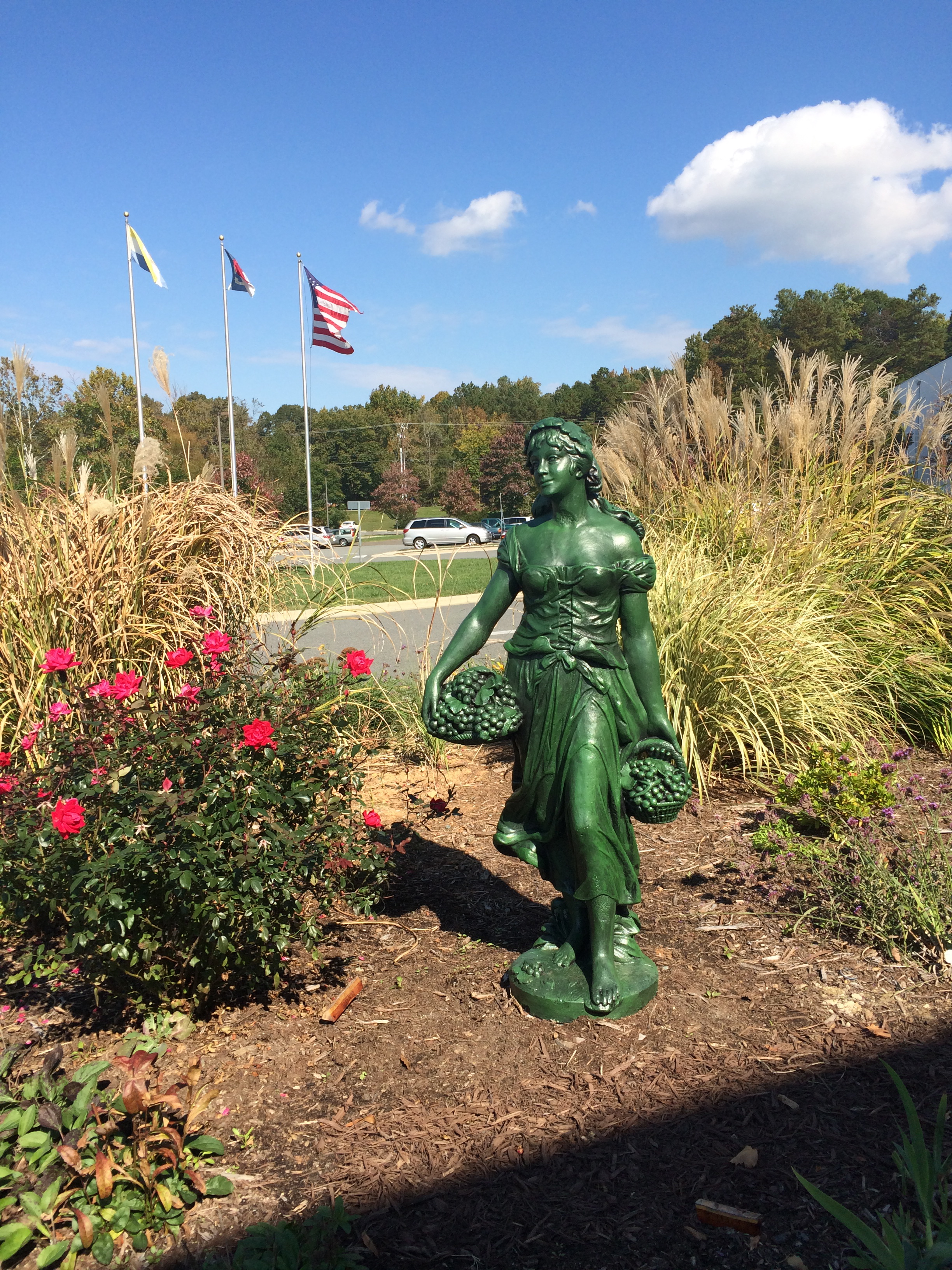
Demeter statue in front of my gym in Hillsborough, North Carolina

Demeter statue in front of my gym in Hillsborough, North Carolina

.

So what is a lamentation? The Oxford English Dictionary defines it simply: “The passionate expression of grief or sorrow; weeping.” Anyone who has grieved knows instinctively what it is to lament the loss of someone who is dearly loved. The feeling is painful and deep, and I think this resonates within us all. Demeter mourned her daughter’s abduction to a point where the earth nearly perished. This poem begins with her not yet knowing all that has happened. I picture her as a mother desperate to know what has happened to her child.

.

This is one of two lamentations of Demeter I’ve written. The second will follow at some point.

Demeter

Demeter

.

To listen to an audio recording of me reading this poem, click on the link below and wait a few seconds for it to begin:

.

.

The First Lamentation of Demeter

.

How is it that I don’t know where she has gone?

        I warned her.

I told her time and time again not to trust them,
that there were those who so longed for her
they would stop at nothing.

        And who was right?

Like all girls her age, she could be headstrong,
believing her own mother too old
to understand those yearnings.

         I warned her.

Last night I watched the dog star rise up.
Its magnificent beams were like beacons
that might lead me to my lost child.

        Why is it the stars are silent?

O, Sirius, your brilliant rays reach down
to us and yet your silence is puzzling.
Surely you saw where she went, my only child.

        Will no one tell me where my Persephone has gone?

.

.

Grief-Statue

Is Mythology More to Your Liking?

Now that it is early autumn, we tend to stay inside more and even read more (at least that’s my experience). Someone recently asked me if I would do the audio recording for some of my mythology poems on this blog. I had done one already, so it does seem natural to now do the others. I hope you like them. My style of reading isn’t dramatic, and I do try hard to avoid “poet voice,” something I dislike very much. Hopefully my readings are pretty natural, maybe too natural for those who do like more drama. I guess it’s all a matter of taste.

By clicking on each link, you will be directed to the original posting for the poem but with the audio now included. I hope you like them.

Grief

                     Grief

The First Lamentation of Demeter:

The First Lamentation of Demeter ~ (Poetry and Myth)

The-Abduction-Of-Persephone-By-Hades

The-Abduction-Of-Persephone-By-Hades

Second Lamentation of Demeter:

The Second Lamentation of Demeter ~ (Poetry and Myth)

feather-lake-russia_71645_990x742

Icarus I

https://apoetintime.com/2014/10/10/icarus-i-poem-by-mary-kendall-mythic-poetry-series/

dark-lake

Icarus II

Icarus II (Poetry and Myth)

And, while we are at it, here is one other poem on this blog linked with mythology:

Orpheus and Eurydice by Rodin, Metropolitan Museum of Art

Orpheus and Eurydice by Rodin, Metropolitan Museum of Art

The Broken Promise: Orpheus and Eurydice

The Broken Promise: Orpheus and Eurydice, poem by Mary Kendall (Mythic Poetry Series)

The First Lamentation of Demeter ~ (Poetry and Myth)

 British Museum GR 1885.3-16.1 (Terracotta C 529), AN34724001

British Museum GR 1885.3-16.1 (Terracotta C 529), AN34724001

I’ve been looking over my writing notebooks written a while back but unread by anyone other than myself or my husband. The myths of Demeter and her daughter, Persephone, fascinate many including me. For a number of reasons these myths seem to appeal especially to women. Many of the great living women poets have written brilliant poems about Persephone (e.g., Louise Glück and Eavan Boland). The story is timeless.

In today’s poem I’ve written a Lamentation of Demeter. Demeter, the goddess of the harvest and grains, is often referred to as the mother-goddess since she represents fertility on earth. Her importance is indisputable. When she mourns for her missing daughter, Persephone (who has been abducted by Hades and taken down into the underworld by force) the seasons stop. Things stop growing and the earth begins to die before Persephone’s father, Zeus, intervenes.  You know the story, but it is worth re-reading if you haven’t read any mythology for a while.

Demeter statue in front of my gym in Hillsborough, North Carolina

Demeter statue in front of my gym in Hillsborough, North Carolina

So what is a lamentation? The Oxford English Dictionary defines it simply: “The passionate expression of grief or sorrow; weeping.” Anyone who has grieved knows instinctively what it is to lament the loss of someone who is dearly loved. The feeling is painful and deep, and I think this resonates within us all. Demeter mourned her daughter’s abduction to a point where the earth nearly perished. This poem begins with her not yet knowing all that has happened. I picture her as a mother desperate to know what has happened to her child.

This is one of two lamentations of Demeter I’ve written. The second will follow at some point.

Demeter

Demeter

To listen to an audio recording of me reading this poem, click on the link below and wait a few seconds for it to begin:


The First Lamentation of Demeter

How is it that I don’t know where she has gone?

        I warned her.

I told her time and time again not to trust them,
that there were those who so longed for her
they would stop at nothing.

        And who was right?

Like all girls her age, she could be headstrong,
believing her own mother too old
to understand those yearnings.

         I warned her.

Last night I watched the dog star rise up.
Its magnificent beams were like beacons
that might lead me to my lost child.

        Why is it the stars are silent?

O, Sirius, your brilliant rays reach down
to us and yet your silence is puzzling.
Surely you saw where she went, my only child.

        Will no one tell me where my Persephone has gone?

Grief-Statue