Some Thoughts on Turning to Myth: Looking back at “The First Lamentation of Demeter ~ (Poetry and Myth)”

A Note to My Readers:

Here it is January 2026. My blog has been quiet this year for a number of reasons too long to list.  But the most obvious reason is that of a block or mental ‘resistance’ to writing. Last year in 2024,  I turned to sharing a few older poems of mine that I love. It was a good reminder to me of why I loved writing.

Today, WordPress showed me my latest stats. I rarely look at these anymore, but one thing I notice each time I see an update is that some of the poems I wrote relating to classical myths seem to be accessed the most. I wonder if, in this sad and tumultuous world and country (mine being the USA), we turn to mythology to find answers to timeless questions that appear and reappear over a lifetime. Who are we and why are we here? What is it we are looking for? What really matters? I am now 79.  Those questions and many more have come up time and time again, and the answers have been quite varied over eight decades. What do you, dear reader, think? Why do we cling to myths and tales from long ago and from cultures we know only though history books, literature or art? I’d love to know what you think.

To honor some of these poems, I’m going to post my two Lamentations of Demeter, one at a time. To save some work, I’ll post the whole original poet from my blog. I hope you find some meaning in each of them or perhaps a way to think of something beyond our wild world of today.


 British Museum GR 1885.3-16.1 (Terracotta C 529), AN34724001

British Museum GR 1885.3-16.1 (Terracotta C 529), AN34724001


Here is the original 2014 posting:

.

I’ve been looking over my writing notebooks written a while back but unread by anyone other than myself or my husband. The myths of Demeter and her daughter, Persephone, fascinate many including me. For a number of reasons these myths seem to appeal especially to women. Many of the great living women poets have written brilliant poems about Persephone (e.g., Louise Glück and Eavan Boland). The story is timeless.

.

In today’s poem I’ve written a Lamentation of Demeter. Demeter, the goddess of the harvest and grains, is often referred to as the mother-goddess since she represents fertility on earth. Her importance is indisputable. When she mourns for her missing daughter, Persephone (who has been abducted by Hades and taken down into the underworld by force) the seasons stop. Things stop growing and the earth begins to die before Persephone’s father, Zeus, intervenes.  You know the story, but it is worth re-reading if you haven’t read any mythology for a while.
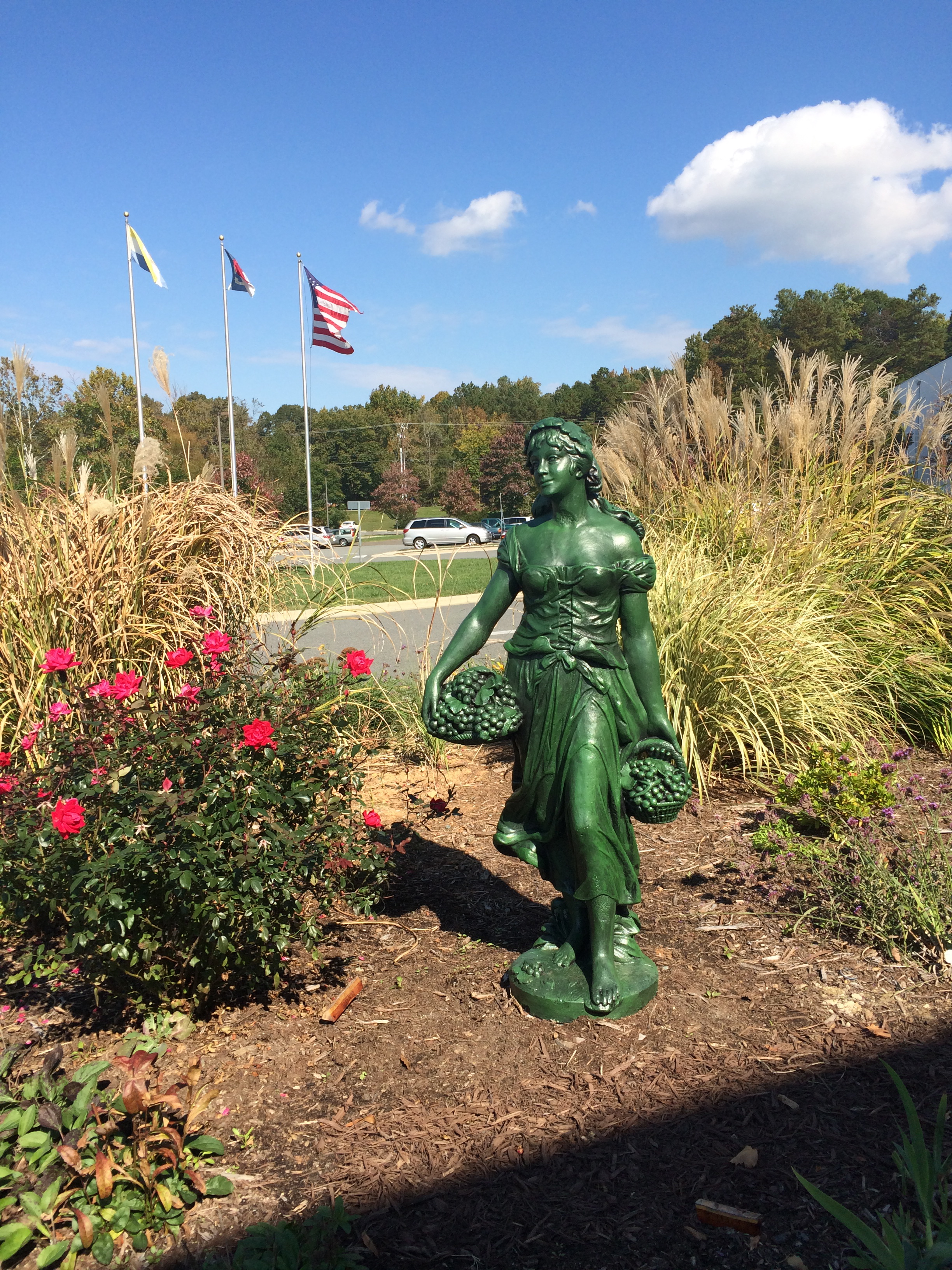
Demeter statue in front of my gym in Hillsborough, North Carolina

Demeter statue in front of my gym in Hillsborough, North Carolina

.

So what is a lamentation? The Oxford English Dictionary defines it simply: “The passionate expression of grief or sorrow; weeping.” Anyone who has grieved knows instinctively what it is to lament the loss of someone who is dearly loved. The feeling is painful and deep, and I think this resonates within us all. Demeter mourned her daughter’s abduction to a point where the earth nearly perished. This poem begins with her not yet knowing all that has happened. I picture her as a mother desperate to know what has happened to her child.

.

This is one of two lamentations of Demeter I’ve written. The second will follow at some point.

Demeter

Demeter

.

To listen to an audio recording of me reading this poem, click on the link below and wait a few seconds for it to begin:

.

.

The First Lamentation of Demeter

.

How is it that I don’t know where she has gone?

        I warned her.

I told her time and time again not to trust them,
that there were those who so longed for her
they would stop at nothing.

        And who was right?

Like all girls her age, she could be headstrong,
believing her own mother too old
to understand those yearnings.

         I warned her.

Last night I watched the dog star rise up.
Its magnificent beams were like beacons
that might lead me to my lost child.

        Why is it the stars are silent?

O, Sirius, your brilliant rays reach down
to us and yet your silence is puzzling.
Surely you saw where she went, my only child.

        Will no one tell me where my Persephone has gone?

.

.

Grief-Statue

So many bodies in Bucha…


This is the first of two tanka published in:


Gusts No. 36 Contemporary Tanka  
fall/winter 2022


so many bodies in Bucha,
even more mass graves
are dug and quickly filled
. . . no mourners, no prayers
at the gravesite today


ukraine-gc49e105c4_640

Some Poems for Ukraine

.

 Two tanka recently published in Red Lights,
Volume 18, no. 2, June 2022

.

.

with ruins, rubble
and death on the news,
we learn their names—
Mariupol & Lviv,
Bucha and Donbas

.

.

image after image of
bombed out buildings and corpses –
far away in my corner, prayers
& more prayers that you will
always rise from the ashes

.

.

ukraine-gc49e105c4_640

Image by bookdragon from Pixabay

Widowhood


Published in FROGPOND, Volume 43:1, Winter 2020:


widowhood

day blurs into evening

into night . . .


This poem is dedicated to my dear sister-in-law, Paulett Brylinski, who lost her beloved husband, Jimmy, in December 2017. Watching her learn to cope and live with grief has taught me so much about courage and love.


Woods Hole, MA – 3/30/14


Life

Two tanka were published in


Eucalypt Issue 27, 2019


miscarriage—
the very word
betrays
the promise
of hope


persimmon sun
dips low and sets –
moonlight on the bed
where I was born
& where my father died


Dove photo by Merlune


Loneliness . . . (three tanka)

Blithe Spirit, Journal of the British Haiku Society,
Volume 28 Number 4, November 2018


Three tanka were published in Blithe Spirit this past November:


 Snow Landscape by Hans Braxmeier


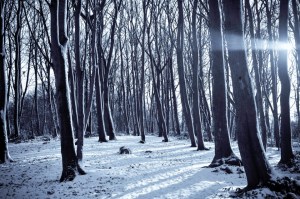
winter woodland

bereft of birdsong 

           with your passing 

even clear days

are shadowed


Photo by Frantisek Krejci


together so long

we seem to finish

one another’s  sentences,

fluent in the pauses

of each other’s mind


Universe by Gerd Altmann


loneliness

comes and goes,

dancing around

my mind

with two left feet


finding a way back . . . (four Senryu)


Part 2:
Prune Juice, A Journal of Senryu, Kyoka,
Haibun and Haiga,
Issue 26 – November 2018


Four Senryu:


reproach –
finding a way back
from heated words


~


overanalyzing–
the smell of wood smoke
on the wind


~


winter walk
learning to negotiate
what can’t be seen


~


the house
where I was born
weeds & more weeds


          Photograph by Marina Shemesh

Hospice window (a haiku)

My first time in this journal.


Haiku Canada Review, October 2018


hospice window

cherry blossoms

fade and fall


heart in pink

Rain patter . . .(3 tanka)


Three tanka published in one my very favorite journals.


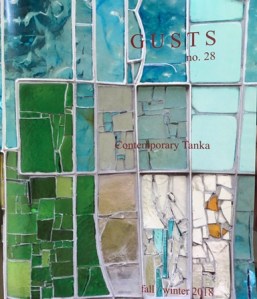
GUSTS No. 28, Contemporary Tanka
(fall/winter 2018)


pounding rains

& the peonies are lost –

how did I miss

your pallor, your reticence

that last day?


turning from pale gold

to dusky violet

our last embrace

so certain

so final


rain patter

on windows –

just when it seems

the darkness is over

it all begins again


YIRtnskUQyitIZ2kaY+Q2Q_mini_1464

Wild apple (some senryu)

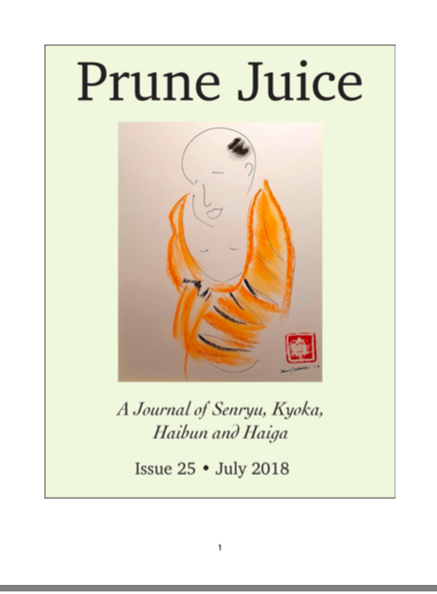
Three senryu and one haiga appeared in Prune Juice, Journal of Senryu, Kyoka, Haibun & Haiga, Issue 25, July 2018.


wild apple–
one bite is all
it took


inertia–
a thin coat of dust
on his burial urn


cloud cover–
darkness brewing
in daddy’s words


the sudden diagnosis haiga


My thanks to editor, Steve Hodge.


Screen Shot 2018-09-28 at 12.32.04 PM

Cover Art: Happy Monk by Jerry Dreesen


A wash of deep blue . . . (haiku)

This poem was selected as an Editor’s Choice (EC) – Haiku in cattails by Geethanjali Rajan, haiku editor of this journal, whose comments are given here:


Screen Shot 2017-10-14 at 4.02.35 PM

Published: cattails: The Official Journal of the United Haiku and Tanka Society October 2017 Issue


The pale twilight


pale twilight 2.png


Tanka by Mary Kendall (c) 2017

Faded numbers… (haiku)


faded numbers
tattooed on your arm
I slip back in silence
.

~Mary Kendall~


Published in Presence 58 July 2017
.
.
Back story on this tanka. In 1972 I visited friends in Israel. As a tourist, I was eager to see the historical sites, one of which was Masada, site of a group suicide where a Jewish community was surrounded by Roman soldiers. The Jews chose suicide rather than be taken as captives. As I stood high up on the hilly site with other visitors, it was very, very quiet. It was after all a sacred place. An older man stood next to me, and I happened to glance at him also looking out at where the soldiers would have been waiting, hoping to starve out the isolated Jewish community. I noticed on his arm, faded numbers–numbers, of course, indicating he’d been captive in a Concentration Camp. The poignancy of him being there has stayed with me for over forty years. Never again, please Lord, shall we do such things to our fellow men.

Both pictures are from travel sites to and in Israel. Masada is located in the Judean desert, very close to the Dead Sea. Visiting these sites is like stepping back two thousand years. I am so grateful for having had this opportunity to visit.

In Memoriam: Maya Lyubenova


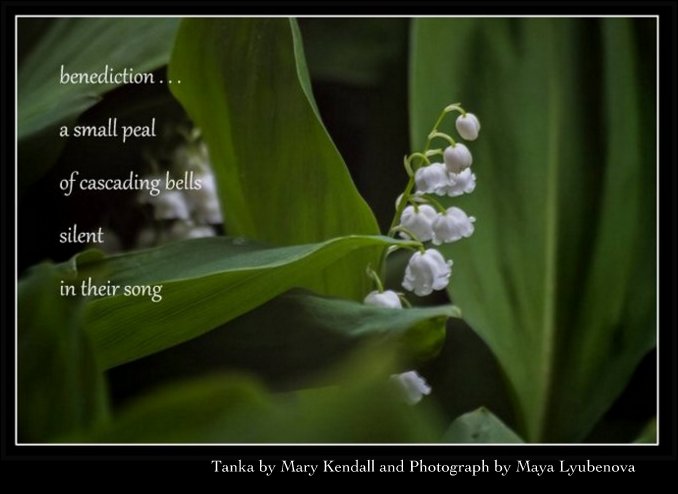
benediction tanka art


Last year I posted a request in a Face Book haiku/tanka writing group asking if anyone had a photo of Lily of the Valley that they were willing to share and allow me to use for a piece of tankart I was working on. A very quick response from the poet/photographer Maya Lyubenova gave me the perfect picture. I never really knew Maya. We’d never met, and we chatted only a few times on FaceBook in poetry groups and on Face Book Messenger. I was certainly a real fan of hers. Bulgarian by birth, Maya could compose gorgeous haiku in English. She could also pair her poems with her equally exquisite photographs to create haiga — visual poetry of the highest quality. I was touched by her generosity in allowing me to use the photo she had sent.


Only recently did I learn that Maya Lyubenova had passed away on December 30, 2016. Like so many, I mourn her loss as a person and as a poet and artist. I wish I had known her better, but I cannot change that. Her work still remains for us to look at, to study, to learn from and to be dazzled by … that will not end.


I’d like to dedicate my piece of tankart to Maya Lyubenova — our single connected piece of art. Thank you, Maya, for bringing so much beauty into this world. May you rest in peace.


Maya Lyubenova’s website:  

http://mayalyubenova.wixsite.com/maya-lyubenova

The link to her amazing haiga:  

http://mayalyubenova.wixsite.com/maya-lyubenova/haiga


Trying hard to hold on … (two tanka)


IMG_4495

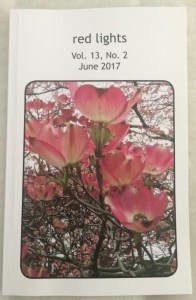
Red Lights, Volume 13, No. 2, June 2017


peeling an orange

in one long strand –

trying hard to hold on

to all I remember

of those now gone


a wooden pew

empty and waiting . . .

colored light

from stained glass

cupped in my hands


My thanks to editor and poet, Marilyn Hazelton, who published these tanka in the most excellent Red Lights.

Unforgettable…


I’ve had two haiku and one haiga included in the newest edition of Wild Plum, a haiku journal, 3:1 Spring & Summer 2017.


unforgettable—
the taste of zinfandel
on your lips


forgiveness
the new year’s moon
lights the way


mourning-haiga


March brings lots of wonderful poetry journals. Another favorite of mine is
Wild Plum, a haiku journal, 3:1 Spring & Summer 2017. The journal is edited by Gabriel Sawicki. This journal is based in Poland, and it has a very international group of readers and contributors. The haiga editor is Maria Tomczak. I hope you will go to their journal directly and read it in full. It’s a very beautiful journal (lovely cover art by Azi Kuder. I’ve added a link at the bottom of this posting.


screen-shot-2017-03-04-at-4-33-14-pm


Here’s a link to the complete version of this  lovely haiku journal:

screen-shot-2017-03-04-at-4-55-05-pm

Wild voices . . . an anthology by women poets and artists


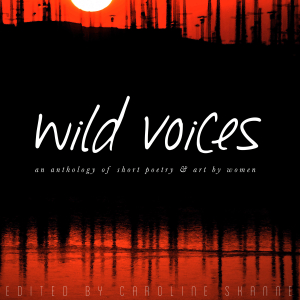
It is very exciting to be part of a collection of poems and art by so many women I admire. Thanks to editor (and poet), Caroline Skanne, I have a haiku and three tanka included. The title and theme of “wild voices” was given to us to interpret in any way we chose. I urge those of you who love poetry to purchase a copy of this anthology for yourself and/or for a gift.

wild-voices-cover


Wild Voices, An Anthology of Short Poetry & Art by Women
edited by Caroline Skanne, February 2017


***book available:https://wildflowerpoetrypress.wordpress.com/current-titles/
This title is also available on amazon.com or amazon.co.uk


 Here are my poems that appear in this lovely anthology:


the softness
of a raspberry
on my tongue…
I remember our long
first kiss


wild honeysuckle
heady and sweet—
your hold
on me
just as strong


a softness of spring
flecked with apple blossoms ~
the morning you died
darkness swept in
lost and wild


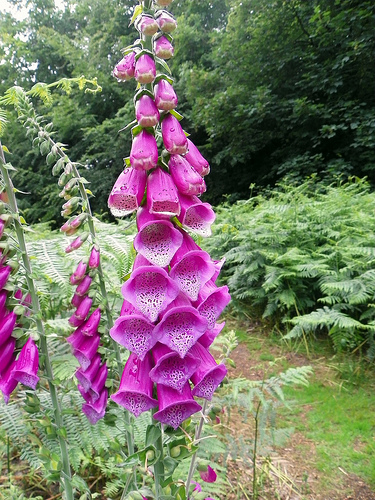
foxglove—                                                                                
danger hidden
in such beauty


foxglove

Foxglove, also known as Digitalis purpurea


Orion stands watch… (tanka)

If you choose to hear this tanka read aloud, simply click on this link:


orion-stands-watch

I am so pleased to be published for the first time in Red Lights. Edited by Marilyn Hazelton, Red Lights is one of the quality tanka journals.

Walking Away

Where do poems come from? Anyone who writes poetry asks that question and has that question asked of them by others who wonder how a poem comes to be. There are many articles and books on the subject, but still there is no single answer. Every poet writes differently and often in a lifetime writing patterns and habits might change, too.

To show you how oddly this can happen, I’ve decided to post a poem that appeared in my chapbook, Erasing the Doubt (published 2015 by Finishing Line Press). “Walking Away” is  a poem that has its own style, its own cadence and its own meaning. If I were to read this somewhere, I think I’d say it feels very much like an old fashioned poem, as if it echoes a voice from long ago. How did that happen? There is an unusual story behind this poem and how it came to be. It came to me as a whole poem when I was up late writing and suddenly became very, very tired. It appeared almost dreamlike to me. I typed it up quickly, read it once and went to bed. When I read it the next day, it didn’t feel or sound like me, but obviously I had written it. Strange indeed. This experience happened only once in my life.Was another poet speaking through me? Or was this merely a side freed from regular consciousness because of fatigue?

I’d love to hear your comments on this poem and what it means to you when you read it. Feel free to leave a message

I’ve recorded this poem if you care to listen as well as read. Just click on this link:

610980-bigthumbnail

Walking Away


When you go, where do you wander?
When you leave me, do you look back?
I sit here, book in hand, not reading.

           The wind blows fiercely through now.


They asked how long you had been silent,
And I answered with a lie, which
Was not the truth but might have been.

          The wind blows silently through now.


Did you hear me whispering to you?
Did you hear what I had to say? Or did
I turn away and only mouth the words?

          The wind blows piercingly through now.


Where do you go when you wander?
Tell me what you see. When you look
At me, I feel you walking away.

          Lamenting the darkness, the wind blows softly now.


1-IMG_1133

“Walking Away” was published in Erasing the Doubt by Mary Kendall (c) 2015, Finishing Line Press.


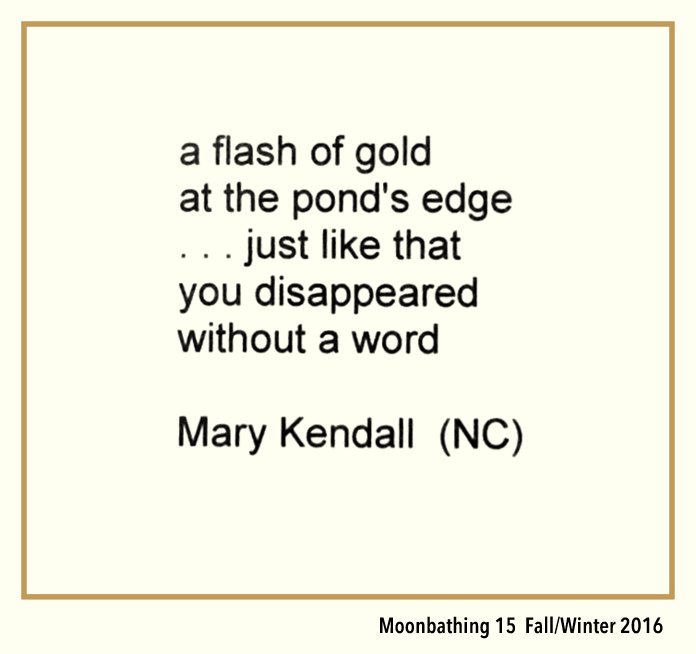
A flash of gold…(tanka)

img_2586


moonbathing-15


It is always an honor to have a poem appear in Moonbathing, A Journal of Women’s Tanka.
Issue 15
Fall/Winter 2016

Edited by Pamela A. Babusci

Grief (a haiga)

grief haiga kendall


Screen Shot 2016-08-31 at 11.39.35 AMThis haiga was published in Wild Plum, a haiku journal, 2:2 Fall & Winter 2016. 
My warmest thanks to the editors, Gabriel Sawicki and Maria Tomczak.


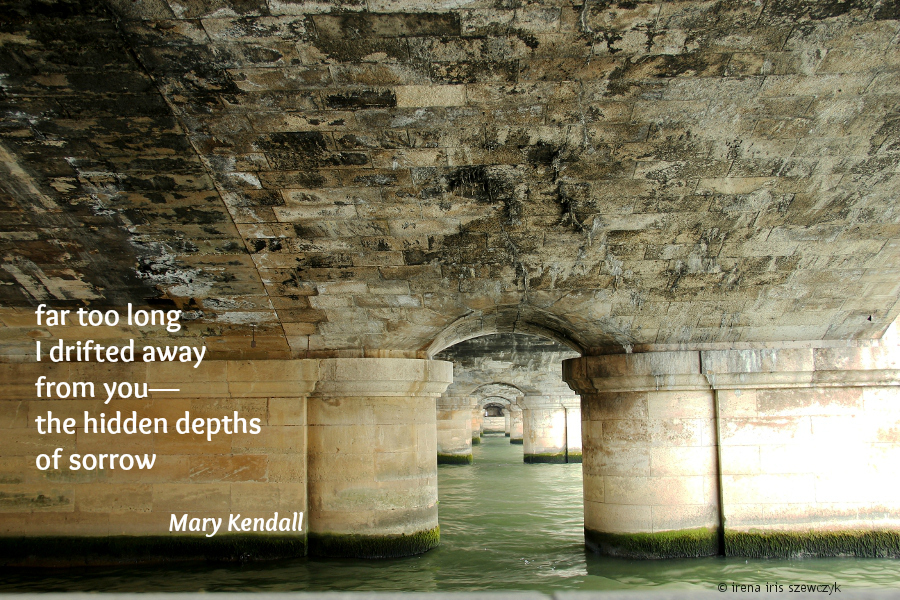
The hidden depths of sorrow

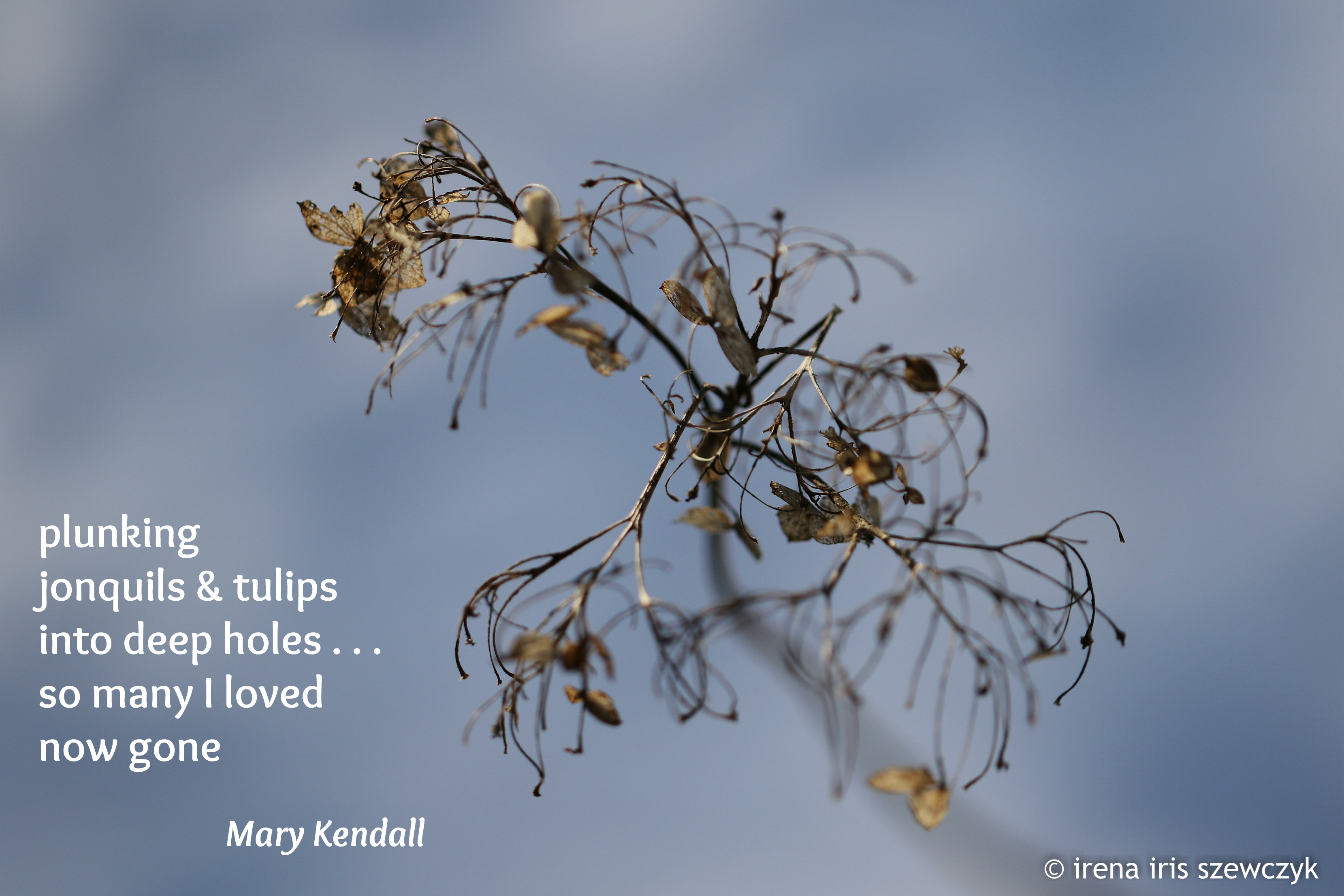
Another pairing of a tanka of mine with a stunning photography by Irena Iris Szewczyk that was published in Frameless Sky 4 (Summer 2016). I am amazed at how perfectly they matched…a big thank you to Christine L. Villa, editor of Frameless Sky for her excellent work and to Irena Iris Szewczyk for her beautiful photograph.

This link below is of me reading this tanka:


031


So many I loved now gone

In Frameless Sky 4, my tanka was set to this beautiful photograph of Irena Iris Szewczyk. My warmest thanks to Irena Iris Szewczyk and to Christine L. Villa, editor of Frameless Sky. I will be posting others from this fine video publication in the next week.

A link to me reading this tanka is given below:


071


A Few Extra Notes:

Irena Iris Szewczyk is both a distinguished photographer and haiku poet. Irina blogs at Iris Haiku where she posts her photographs and her haiku:                                           http://iris-haiku.blogspot.com

Her artwork for Frameless Sky 4 can be seen here:  http://framelesssky.weebly.com/artwork.html

Christine L. Villa is editor of Frameless Sky. She is a distinguished poet herself. Her blog is called Blossom Rain and is located here:  http://blossomrain.blogspot.com

Frameless Sky can be found here: http://framelesssky.weebly.com

You departed…

One of the finest journals around for Japanese short form poetry has been A Hundred Gourds. The editors announced several months ago that the June issue would be the last issue. This is a great loss, but there is an amazing amount of work editors do to make a journal of this caliber work so well.  The tanka editor, Susan Constable, is one of the finest poets around, and her skill and advice as an editor is special. I know I have learned a great deal from her through our correspondence this past year. My thanks go to all the excellent editors of this journal. I am fortunate to have two tanka selected for this final issue of A Hundred Gourds. I will be posting them separately, one today and one tomorrow.


2-A Hundred Gourds 2 June 2016

A Hundred Gourds 5:3 June 2016

hospice…

The Heron’s Nest, Volume XVIII, Number 2: June 2016


1-hospice haiku


Compassion (a poem about depression)

Depression is not very pretty. Nor is it very kind. It has many faces, and it comes and goes as it pleases. It can affect almost anyone. If you are someone who has struggled with depression, you know it never goes away completely but hides, waiting for the right moment to reappear. It isn’t something to be lightly dismissed in yourself or in others who suffer from it. Who hasn’t seen the devastating effect it can have on a vulnerable person? I’ve struggled with it, and I’ve certainly known many others who were also affected by it.

.

Watching someone you love battle depression is never easy. It isn’t easily “fixed,” even in this age of modern medicine. Therapy and medicines are there, and for some people they help so much, but for others, less so. Compassion, patience, unconditional love and presence are the lifelines we can offer…to someone else and to ourselves.

.

To listen to me read this poem, please click on the link below. It will take a minute to begin.

.

.

Compassion


Taking on your pain was something
I tried to do, like slipping on your
jacket, pushing an arm in and then
another, pulling it tight around myself,
hoping that by feeling what you do,
it would diminish your pain.


No matter how hard I tried, it wasn’t a fit.
Your depression fell around me in loose
folds, the sadness sagging around my heart.
Besides, it would leave you cold, open
to the fickle winds that blew your way.


Compassion was first published in Erasing the Doubt by Mary Kendall
(Finishing Line Press © 2015)


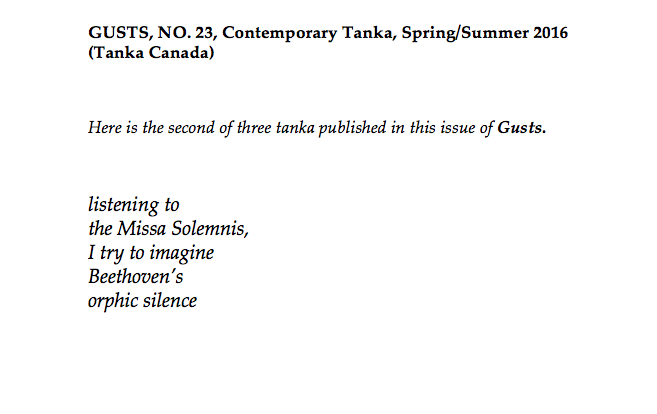
Gusts ~ Tanka #2

Screen Shot 2016-04-15 at 12.02.35 PM


missa-solemnis_6900


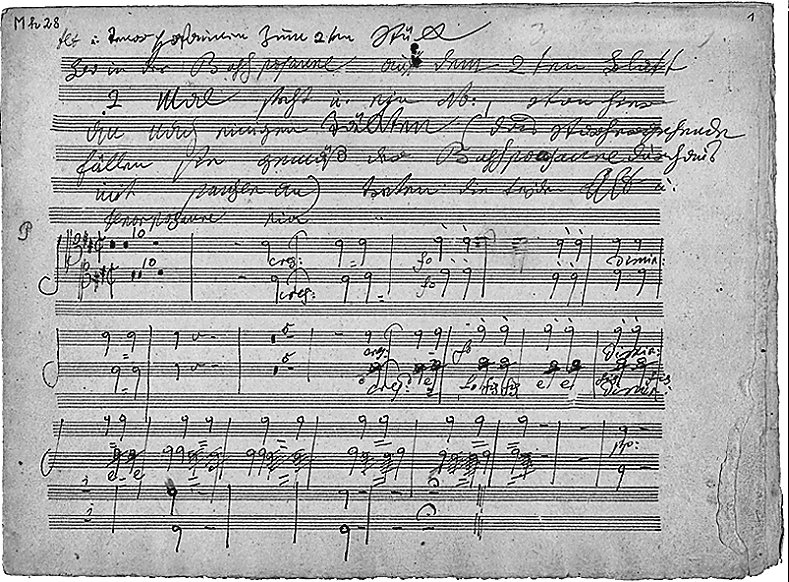
Missa Solemnia Mss

Gusts ~ Tanka #1

Gusts Summer 2016


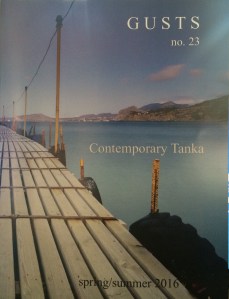
I’ve had the good fortune to have three of my tanka published in the latest issue of GUSTS,
NO. 23, Contemporary Tanka, Spring/Summer 2016 (Tanka Canada). This is the first time my work has appeared in this beautiful poetry journal, and I’m most grateful to the editor, Kozue Uzawa.

I’ve decided to post each tanka separately here on my blog.

Screen Shot 2016-04-15 at 12.01.34 PM


Brushing Your Hair

1-IMG_1141


Brushing Your Hair

In the last month you ask me a favor.
Will I brush your hair when you have passed?
You seem to want to greet whatever comes
looking your best. I give my promise.

Each day when I come home, I offer
to brush your hair, but you say no,
maintaining the independence
you have always shown.

Later, in hospice, I no longer ask.
I hold your hands, rubbing lotion in,
skin so fragile, like a butterfly wing.
It is time now to make the last ablutions.

I clean your face and brush your hair,
your sleeping eyes flicker
under paper-thin lids, pale blue veins
tracing their course across them.

I imagine your mother tenderly holding you,
stroking your cheek, watching you dream
in her arms—her newborn daughter
with milky breath.

Ninety-one years separate us, your two watchers.
One joyously bringing you into the world;
the other sitting silently in the dim-lit room,
keeping watch over you through the night.          


1-IMG_1133


The poem, “Brushing Your Hair” is from my chapbook, Erasing the Doubt (c) 2015, Finishing Line Press.


Transformation and the Ineluctable Signs of Ageing, prose poem by Mary Kendall (My Meta-Morphosis Series)

My thanks to Silver Birch Press for including my poem in this wonderful series. I have been enjoying reading all the poems posted, each so different from the others.

silverbirchpress's avatarSilver Birch Press

Takahashi_Biho-No_Series-Dragonfly_and_lotus-00034829-030804-F06
Transformation and the Ineluctable Signs of Ageing
by Mary Kendall

This is not my first transformation. No, it happened way back when—six decades and then some, and I find myself no longer who I thought I was just ten, twenty or even thirty years ago. Those were other lifetimes, times I lived through, times I felt so alive, enjoyed, loved, and times I remember, but those were lives I knew I had passed through completely.

I have the evidence.

Now, going further back in time—forty or fifty years ago, it all begins to change. It starts to slow down—slow—slow—slow—as if someone has put a finger out and touched the spinning world—and now it slows down enough as if I must to look for a place to rest.

This viewing backwards makes me dizzy—dizzy—dizzy enough to want to keep traveling back to the end, which in fact is the beginning, and…

View original post 500 more words

Small Poems of Grief

Grief, by iosatel, (c) 2014, The Obvious and Hidden blog: http://theobviousandhidden.com/2014/11/04/grief/

Grief, by Iosatel, The Obvious and Hidden blog, (c) 2014

1.

only the bereaved know
they needn’t speak in whispers,

grief is never
completely silenced


2.

rush of water
a broken branch drifts by
what will be left?


3.

Unending days of darkness
that never let you forget.


4.

Saturated, as if the clouds
had wrung themselves out
all at once, watching what
would then ensue


5.

sitting at the window
watching the rain
despondent days
of unexhausted sadness
trying to let go


6.

forgetting you
was never an option


7.

grief exhausts
but holds on,
rain continues
to fall


8.

thirty-five years and still I mourn you,
sometimes waking and imagining you there


9.

darkness deepens
into the black of night

lightning signals
thunder cracks,

but it is the loss of you
who took your life
that makes me ask
why it had to be

 ~~~

My Note of Thanks to the photographer, Iosatel, for his beautiful picture, Grief, which was first posted on his blog, The Obvious and the Hidden on 4/11/14. This photograph is copyrighted (c) 2014 by the artist himself.