A Repeat for Myth Lovers: The Second Lamentation of Demeter by Mary Kendall ~ (Poetry and Myth)

As a follow up to my last blog, I’m reblogging this second lamentation that dates back to November 4, 2014.

Which classic myth would YOU choose to write a poem about? What grabs your mind and heart both?


The Second Lamentation of Demeter
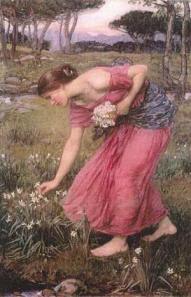


Narcissus, 1912 by John William Waterhouse

Narcissus, 1912 by John William Waterhouse


Persephone’s abduction by Hades is swift, violent and over so quickly that no one hears her scream except for Hecate, a goddess who helps Demeter find out where she has gone. Could there be anything worse for a mother than to lose a child? Demeter’s grief is profound. This is the Second Lamentation of Demeter.
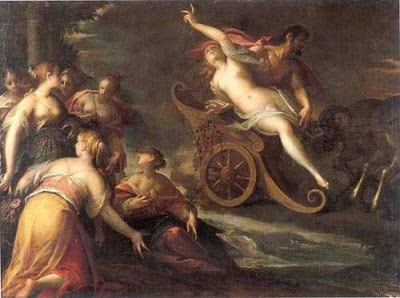
 

The Rape of Proserpine, Hans Von Aachen, 1587

The Abduction of Persephone, Hans Von Aachen, 1587


To hear me read this poem, please click on the link below and wait a few seconds for it to begin.


The Second Lamentation of Demeter


The earth groaned, then opened briefly.
That’s all it took.

He appeared out of nowhere
Like a wild flume of fire,

The flickering golden chariot with
Four black stallions at full gallop.

He sprang upon her so quickly
That when the earth closed back

Upon itself like a wound healed over,
All that was left was a circlet of flowers

That she and the daughters of Oceanus
Had been stringing together. Irises, roses,

Violets, hyacinths, and the faded blossoms
Of sweet narcissus plucked by her hand.

The scar in the earth and grasses torn apart
Were all that told the story.

I always knew he watched her…
I sensed when he was around.

Clouds gathered overhead,
Shadows clothing him in darkness,

Hades,
To whom sunlight is a stranger.

My sweet Persephone is gone now,
Gone with him.

O, horror…
My sweet child is his.


circlet of flowers 2


Persephone’s abduction is well represented in art. It is my personal opinion that one need look no further than the magnificent sculpture done by Bernini in 1622. The details of the hands and arms as well as the force and resistance between their two bodies is powerful. Persephone’s tear stained cheek tells us more than any words can.


Gian Lorenzo Bernini, The Rape of Proserpina, 1622, Galleria Borghese in Rome

Gian Lorenzo Bernini, The Abduction of Persephone, 1622, Galleria Borghese in Rome


(detail)

(detail)
 

(detail)

(detail)

Poor brown moth … (three tanka)


Three tanka published last February in the lovely journal, GUSTS:

Gusts No. 38  Contemporary Tanka, Canada,
Fall/Winter 2024  


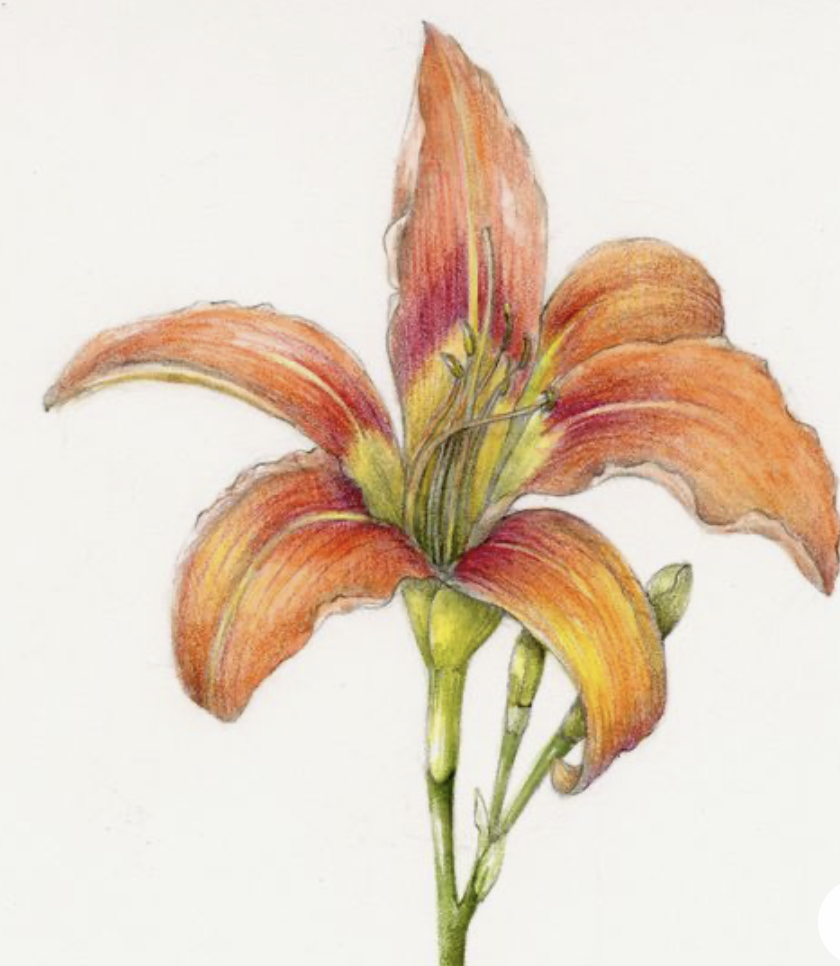
Compliments of “Draw Botanical”


a day lily blooms
for a single day
this brevity
a wonder to some,
unsettling to others


poor brown moth
trapped in a web
      the more you flutter
the tighter those
fine strands pull


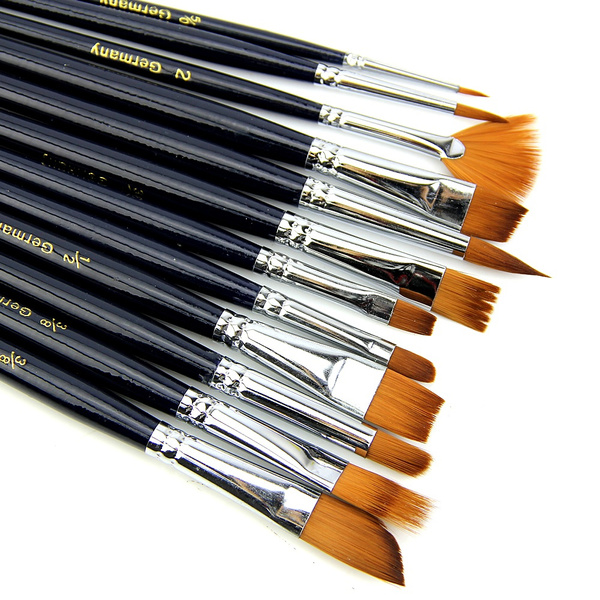
the art aisle holds
such soft sable brushes
wedge, round, pointed, flat
patiently waiting
to adorn my words


Chokecherry


the slow hiss
and sudden pop
of a pinecone in fire—
admitting the mistake
is a first step


*


had you lived
we’d almost be twins,
two sisters
so close in time
we nearly touched


*


this urge
to turn and walk away
     chokecherry


Mary Kendall (c) 2020

Kokako 32, 2020, a journal of the New Zealand Poetry Society
My thanks to the editors of Kokako for publishing all three poems.


We turn away…(tanka)


This tanka was published in Hedgerow, a journal of small poems ~ #130, Winter 2020


we turn away

from all we just can’t face—

the glistening red

of a vulture’s head

emerges from a carcass


Poet’s note:

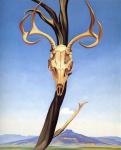
Out of decay comes art and beauty. Look what artist Georgia O’Keefe created from a skull found where she lived in New Mexico. All is part of nature and is nature.


Deer’s Skull with Pedernal by Georgia O’Keefe (c) 1936


Where I live in central North Carolina, we have plenty of black vultures and turkey vultures. They circle and gather in the sky when there is carrion to be had. I chose this topic for the tanka because it’s a scene I’ve seen more than once. Yes, it’s not a pretty sight. Vultures, especially when eating a dead animal or gathering in a group in a tree or abandoned house do give you shivers. Something in us seems to respond with at least a momentary revulsion. However, I’m a bird lover and I try to see how a specific species fits into the scheme of things. Vultures and crows do eat carrion, the flesh of dead animals, often of roadkill along our roads and streets. They perform a good service by eating their meal and cleaning the mess up. Imagine all those dead animals left to rot. So these birds help us as they go about their business (albeit unpleasant business to us). They are birds we should appreciate for their useful role in nature. They also offer us a wonderful metaphor.

My thanks to editor, Caroline Skanne for being the one editor who chose to publish this poem. 

Imagine my surprise … (tanka/kyoka)


Prune Juice, Journal of Senryu, Kyoka, Haibun & Haiga
Issue #30, March 2020


both parents

dead at sixty one –

imagine my surprise

the day I turned

sixty-two


Widowhood


Published in FROGPOND, Volume 43:1, Winter 2020:


widowhood

day blurs into evening

into night . . .


This poem is dedicated to my dear sister-in-law, Paulett Brylinski, who lost her beloved husband, Jimmy, in December 2017. Watching her learn to cope and live with grief has taught me so much about courage and love.


Woods Hole, MA – 3/30/14


Life

Two tanka were published in


Eucalypt Issue 27, 2019


miscarriage—
the very word
betrays
the promise
of hope


persimmon sun
dips low and sets –
moonlight on the bed
where I was born
& where my father died


Dove photo by Merlune


Haiku Holiday turns 40


The North Carolina Haiku Society hosts an all-day meeting on the last Saturday of each April. This year marked the 40th year of these days called “Haiku Holiday.” Each of the past 40 years has been hosted by one wonderful poet and woman, Jean Earnhardt

on Bolin Brook Farm, an old farmstead that has been in her family for 12 generations. Can you imagine opening up your home and garden annually to a large group of poets? Jean does so graciously and with a welcoming, inclusive attitude. Thank you, Jean!


“In honor of the 40th anniversary of Haiku Holiday, we read 40 haiku by current and past members of the North Carolina Haiku Society. Crystal Simone-Smith selected the poems and published them as a broadside.”  (Dave Russo, the NCHS website Editor)


The Broadside is so beautiful, and it’s an honor to be part of this. My two haiku are listed below. My thanks to Crystal for selecting this to be included.


Haiku Holiday, NCHS, 2019

40 Years, 40 Haiku: A Broadside


dandelion—

more and more invisible

as I grow old


our country’s story

ever evolving

. . . fallen blossoms


Both haiku by Mary Kendall (c) 2019


Loneliness . . . (three tanka)

Blithe Spirit, Journal of the British Haiku Society,
Volume 28 Number 4, November 2018


Three tanka were published in Blithe Spirit this past November:


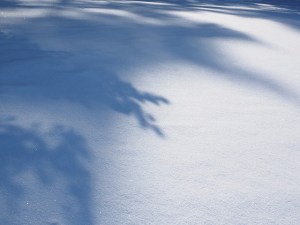
 Snow Landscape by Hans Braxmeier


winter woodland

bereft of birdsong 

           with your passing 

even clear days

are shadowed


Photo by Frantisek Krejci


together so long

we seem to finish

one another’s  sentences,

fluent in the pauses

of each other’s mind


Universe by Gerd Altmann


loneliness

comes and goes,

dancing around

my mind

with two left feet


No second guessing


1.


how many times

can a stone skip

before sinking . . .

deep in my breast

a small lump appears


Unsplash by Linus Nylund


2.


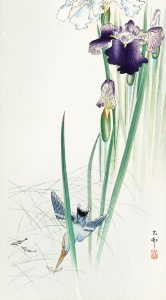
no second guessing a kingfisher’s straight dive


Kingfisher and Irises by-Ohara Koson, The Rijksmuseum, Amsterdam, Holland.


3.

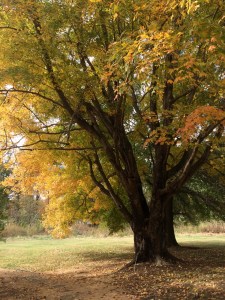
leaves turning –

an old friendship

ends


Golden Tree by Mary Kendall


ephemerae,
an international of haikai, tanka & beyond

Volume 1, C: November 2018


My thanks to Shrikaanth Krishnamurthy for publishing two of my haiku and one tanka in the November issue of ephemerae


Almost . . . (tanka)


Ribbons, the Journal of the Tanka Society of America Fall 2018: Volume 14, Number 3


the long scar

down your chest

almost healed —

so hard to forget

you almost disappeared


Ribbons, the Journal of the Tanka Society of America
Fall 2018: Volume 14, Number 3


Chopping carrots…


failed haiku: A Journal of English Senryu, Volume 3, Issue 32


one haiku:

chopping carrots –
with each decisive cut
I think of you


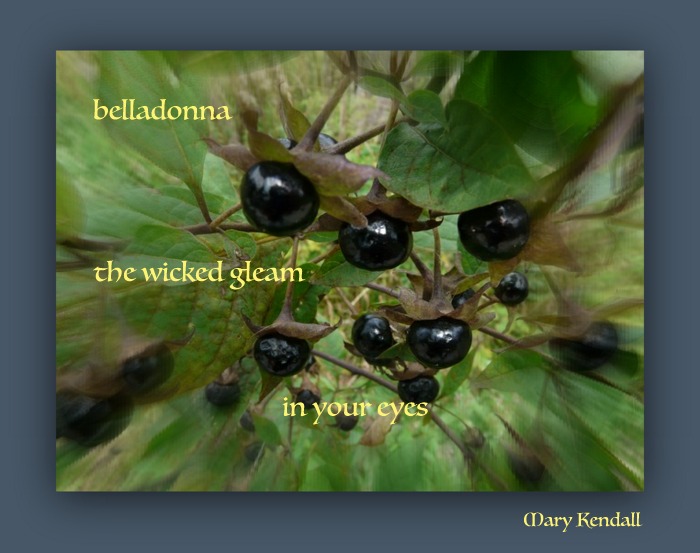
and two pieces of tankart:

belladonna


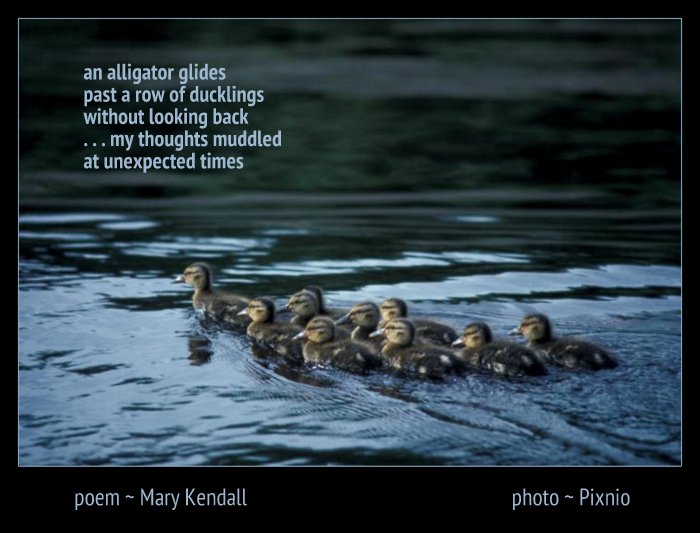
an alligator glides by


Haiku and  Tankart are by Mary Kendall, (c) 2018

best journal and pen

The pale twilight


pale twilight 2.png


Tanka by Mary Kendall (c) 2017

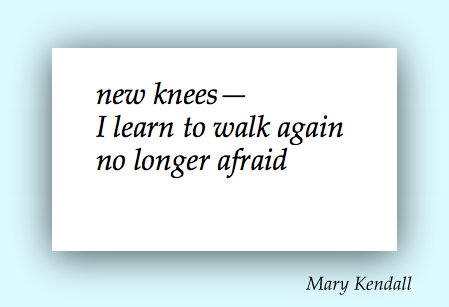
Arm in arm . . . (3 senryu/haiku)

These senryu/haiku were published in the October (2017) issue of Brass Bell, a haiku journal. The theme: Body haiku


arm in armin hospicenew knees


Link to Brass Bell, the journal:  http://brassbellhaiku.blogspot.com

When the Light Departs (a responsive tanka sequence)

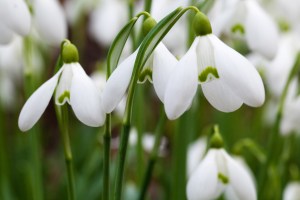
snow-drops-public-domain-picture


Earlier this year, Australian poet and friend, David Terelinck, invited me to create a responsive tanka sequence with him. David is a poet I greatly admire, so it was a real honor to write with him. It was the first time I’d attempted anything like this, but under David’s very gentle and skilled tutelage, our sequence grew and grew. In creating this piece with David, I learned as much about trust as I did about the nuances of writing tanka.

When we finished our sequence, David asked, “Now where shall we send this sequence for publication?” I was dead silent, being a bit in shock that he felt this piece should be published. At his suggestion, we submitted it to Skylark, a Tanka Journal edited by Claire Everett.  Claire is one of the world’s finest tanka poets and editors. She herself has written responsively with David, and he has provided the forward for her last book. Two of my favorite poets alive discussing publication and minor edits. What a wonderful thing to happen.

This month, Skylark, a Tanka Journal, Volume 4, Issue 2, Winter 2016 was published.Here is our tanka sequence, When the Light Departs. My thanks to you, David Terelinck, for being my teacher, mentor and friend.

~

[Note: David’s verses are in regular font and mine are in italics.]

Responsive tanka sequence between David Terelinck (AUS) & Mary Kendall (USA)

When the Light Departs


this alloy
of clouds & winter light –
it’s not what you said
but how you looked
as you said it . . .


still unable
to explain why the world
seems darker now . . .
all the frozen buds
on the camellia bush


days and days
of endless rain that swells
the window sills –
only two weeks left
in her first trimester


a sudden
knowing of what
may never be . . .
the silence of snowdrops
pooling on the lawn 


not the way
she expected to wear
all white . . .
the greying of her thoughts
following sedation


winter storm,
a young dove lost
in a sea of mist
. . . my empty arms
grow heavy


she spends the morning
filling freshly turned beds
with crocus bulbs –
what else can a woman
of a certain age do?


when the light
departs, I put down
my paintbrush . . .
this world of colour
between earth and sky 


© 2016 David Terelinck & Mary Kendall

Published in Skylark, a Tanka Journal, Volume 4, Issue 2, Winter 2016

flower_spring_snowdrop

Note: both photographs are from the public domain

An Honorable Mention . . . (senryu)

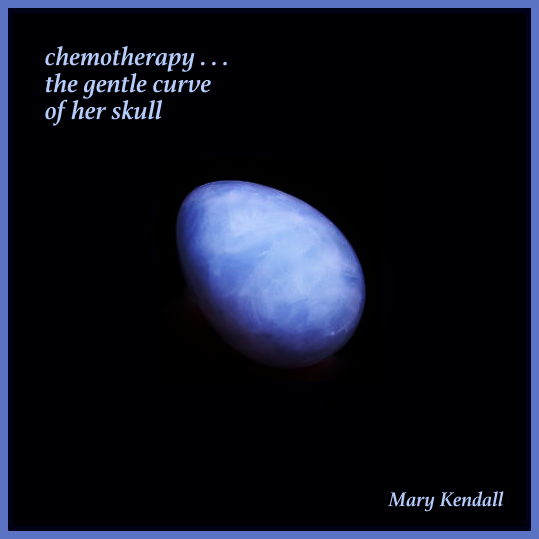
chemotherapy


~ This poem/haiga is dedicated to all who have struggled with cancer. ~

~ ~

A wonderful surprise email told me that a haiga of mine had been selected as an “Honorable Mention, Mixed Media** Category” in the Jane Reichhold Haiga Contest sponsored by two wonderful senryu journals:

Failed Haiku, A Journal of English Senryu Volume 1, Issue 11, edited by Michael Rehling

Prune Juice – A Journal of Senryu, Kyoka, Haibun and Haiga, Issue 20, November 2016, edited by Steve Hodge

The Judges of the contest were: Kris Kondo, Ron C. Moss, Michele Root-Bernstein

Michele wrote the commentary on my haiga: 


With the sparest of words and imagery, this haiga lays bare the essence of life in the face of death. If the poem skirts the uncertain boundary between haiku and senryu, just as certainly the picture skirts the shadowlands of mortality, its single image illuminating the darkness with a pulsating light. So well integrated are text and image that the associative leap between the two has the power of metaphor: the shaved skull is the incubating egg, never mind the incongruity. Avoiding the maudlin and the sentimental, this haiga speaks simply, honestly, of the beauty to be found in the ordinary, ordinarily hidden from view.”

This competition was in honor of the late Jane Reichhold who was such a brilliant poet, teacher, editor and mentor to so many who write haiku, senryu, tanka and other small form poems. I never had the honor of meeting her, but her main book on haiku has been a bible for me and so many others.

**Mixed Media, which can be any combination of traditional and photographic, or computer generated images and text.


Brushing Your Hair

1-IMG_1141


Brushing Your Hair

In the last month you ask me a favor.
Will I brush your hair when you have passed?
You seem to want to greet whatever comes
looking your best. I give my promise.

Each day when I come home, I offer
to brush your hair, but you say no,
maintaining the independence
you have always shown.

Later, in hospice, I no longer ask.
I hold your hands, rubbing lotion in,
skin so fragile, like a butterfly wing.
It is time now to make the last ablutions.

I clean your face and brush your hair,
your sleeping eyes flicker
under paper-thin lids, pale blue veins
tracing their course across them.

I imagine your mother tenderly holding you,
stroking your cheek, watching you dream
in her arms—her newborn daughter
with milky breath.

Ninety-one years separate us, your two watchers.
One joyously bringing you into the world;
the other sitting silently in the dim-lit room,
keeping watch over you through the night.          


1-IMG_1133


The poem, “Brushing Your Hair” is from my chapbook, Erasing the Doubt (c) 2015, Finishing Line Press.


Charlotte’s Story: Haiku for Wilbur by Mary Kendall (ME, IN FICTION Poetry and Prose Series)

silverbirchpress's avatarSilver Birch Press

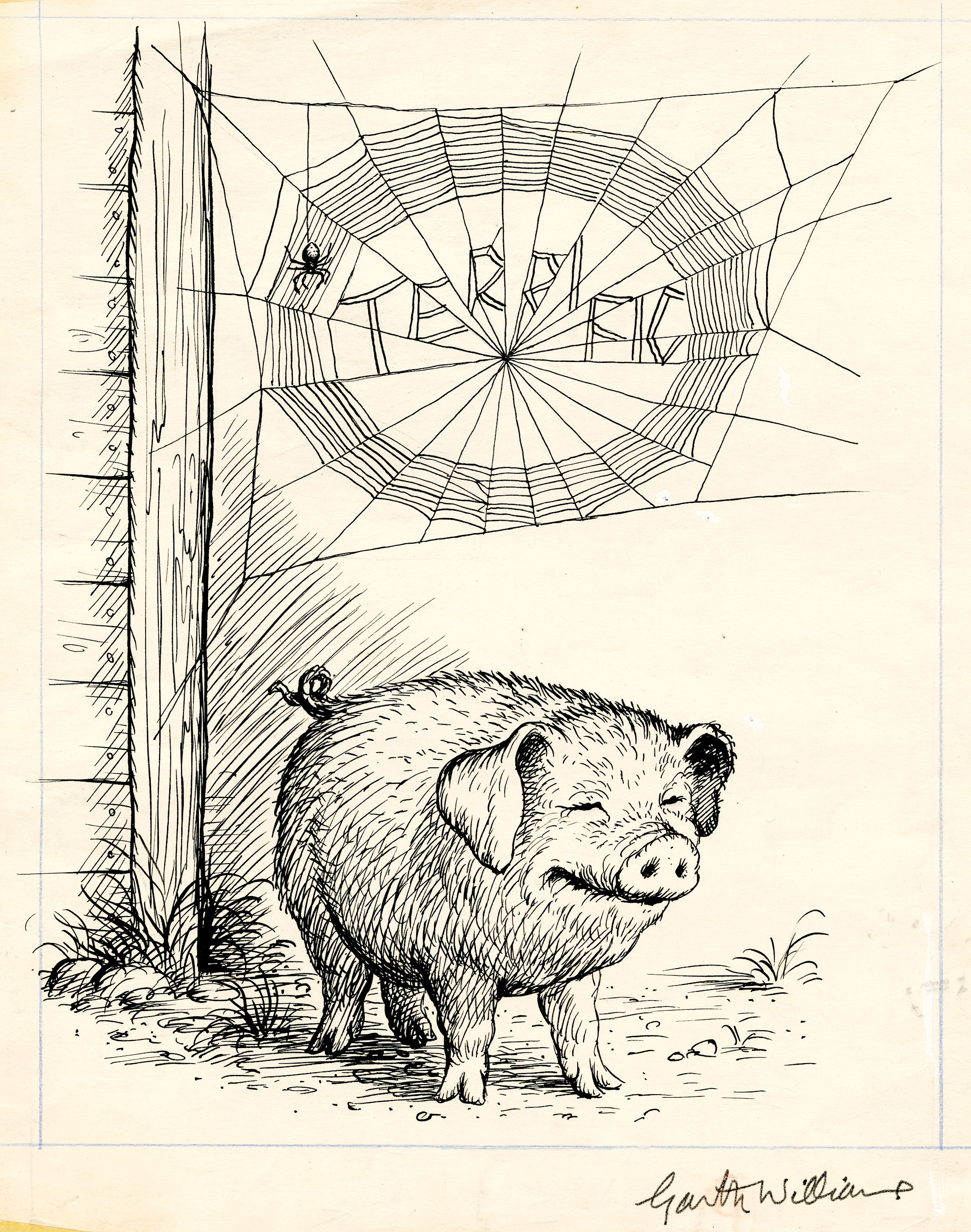
Charlottes-Web-Terrific-Garth-Williams1Charlotte’s Story: Haiku for Wilbur
by Mary Kendall

“My Words”

my words—
who knew what a story
we’d become?

“First Friend”

a friend—
something my kind
never knew

“The Unexpected”

new friend—
silken parachutes in spring wind
bestow surprises

“Silken Words”

silken words…
hearts woven together
in their own story

“Some Pig”

little did they know
how special you were—
some pig!

“Terrific”

a real friend
who accepted me as I am…
terrific!

“Radiant”

just knowing
you have a good friend…
this radiant heart

“I Told You”

out of nowhere
grows the best thing…
kindness of spirit

“Humble”

humble—
your kindness of heart
my friend

“The Fair”

harvest moon—
who knew how high
we’d fly?

“Templeton”

even a rat
can help a friend..
who knew?

“My Time”

time for rest
my voice a whisper
…alone now

“Good-bye”

no need to worry—
our memories will live on
in your heart

“Death”

View original post 261 more words

Kamakura Beach 1333: Artist’s choice in Rattle’s Ekphrastic Challenge

Screen Shot 2015-11-20 at 8.35.28 AM

I am both speechless and honored by the selection of my poem, “Kamakura Beach, 1333” as the artist’s choice of the October ekphrastic challenge by Rattle, one of the finest contemporary poetry journals. The artist/photographer is Ana Prundaru. My thanks go to Ana for selecting my poem for this challenge. I am deeply touched by her very thoughtful and generous comments.


Artist's Comments.jpg

To read the poem or listen to the audio on Rattle, here is the link:

http://www.rattle.com/poetry/kamakura-beach-1333-by-mary-kendall/

Note: there is an audio of me reading the poem on the Rattle page but I’ll include it here as well:

~

Kamakura Beach, 1333                                          


The sea washed scarlet that night.

The tide rushed in—swelling and breaking—washing
all traces out to sea on the waves of Kamakura Beach.

You know nothing of this, you who long for adventure
and pleasure—youth who search desperately for meaning
in lives that are too rich, too busy, and still so poor.

Your small boats arrive in early evening, the carmine sunset
at your back, and you quickly gather driftwood, tinder, and
fallen black pine branches to burn. You light the fire.

A trail of smoke begins funneling up to the starry sky.
The fire burns hot and one by one, you feed it twigs, boughs,
pine cones bursting into streams of sparks and wild flames.

And in your wanton rambling, one girl grows silent—she alone
hears the hallowed chanting, the cries of battle, the shrieks
of arrows piercing skulls, the stench of life exiting too abruptly.

She wanders over shallow rocks, her hand touching stone,
knowing the pain hidden in the silence of eight hundred years.
The rest of you are unaware…you laugh too loudly, move

too fast, not noticing the shifting colors of the setting sun.
Listen and you will hear the shogun cries of warriors and farmers
that once shook the sacred sands of Kamakura Beach.

Can you smell the fierce fires, the burning buildings,
the blazing rafters crashing and lighting the darkening sky?
Can you hear the screams of those buried here long ago?

Time slipped by like swifts at dusk darting in the fading sky.
The fire raged on and on, and lives were ravished in a
single breath. It was our fate to die on Kamakura Beach.

With Samurai mind and clean, sharp blows, the sacred sword
was swift. One by one, we died…each of us choosing honor,
this bleak beach now strewn with bones, bodies and blood.

You who come to visit—feel the cool churning lapis blue water,
and see the late sun boldly brush red on sand, water and waves.
Remember us—we who lie buried on Kamakura Beach.

Let your fires roar, let them spark in comets to the stars.
Under the dark night skies long written in indigo and ink,
we will walk together here on Kamakura Beach.

Morning tide will come—swelling and breaking—washing
your presence out to sea— remembering our final night,
a night of fire and blood, bone and bodies on Kamakura Beach.

The sea washed scarlet that night.


~

Here is the broadside link:

Click to access EAOct2015.pdf

Rattle also posted a download of a broadside that includes poem and picture side by side. It is so beautifully done with the shadows of the boat creating a subtle image under the poem. Very appropriate to this particular poem, I think.


Wild Water ~ Three Tanka

wild water


Wild Water: Three Tanka


1.

throughout the long day

the wild water crashes

again and again—

memories of you silently

slip under water


2.

as evening comes

the tide begins to swell

in the empty sound,

one lone boat

longing to set sail


3.

foghorn rasping

deep and low—

a bleak song

of ships surrendering

to savage waves


The End of Autumn

Red Leaves

                                                                                     “In my End is my Beginning”

The End of Autumn

How could we pass through autumn
without thinking about life.

Life and death.

Life and birth.

Birth and death.

The book ends of our existence
with pauses of space in between
waiting for us to write the chapters
that will fill the empty volume
that eventually defines a life.

Golden Leaves

These photos were taken by me at the Duke Hospice at The Meadowlands in Hillsborough, North Carolina. This hospice is set on an old farmstead in rural Orange county. The hospice and grounds are a wonderful gift to all who pass through.

Quotation embroidered by Mary, Queen of Scots

Quotation embroidered and worn by Mary, Queen of Scots

The Second Lamentation of Demeter ~ (Poetry and Myth)

Narcissus, 1912 by John William Waterhouse

Narcissus, 1912 by John William Waterhouse

Persephone’s abduction by Hades is swift, violent and over so quickly that no one hears her scream except for Hecate, a goddess who helps Demeter find out where she has gone. Could there be anything worse for a mother than to lose a child? Demeter’s grief is profound. This is the Second Lamentation of Demeter.

The Rape of Proserpine, Hans Von Aachen, 1587

The Abduction of Persephone, Hans Von Aachen, 1587

To hear me read this poem, please click on the link below and wait a few seconds for it to begin.


The Second Lamentation of Demeter

The earth groaned, then opened briefly.
That’s all it took.

He appeared out of nowhere
Like a wild flume of fire,

The flickering golden chariot with
Four black stallions at full gallop.

He sprang upon her so quickly
That when the earth closed back

Upon itself like a wound healed over,
All that was left was a circlet of flowers

That she and the daughters of Oceanus
Had been stringing together. Irises, roses,

Violets, hyacinths, and the faded blossoms
Of sweet narcissus plucked by her hand.

The scar in the earth and grasses torn apart
Were all that told the story.

I always knew he watched her…
I sensed when he was around.

Clouds gathered overhead,
Shadows clothing him in darkness,

Hades,
To whom sunlight is a stranger.

My sweet Persephone is gone now,
Gone with him.

O, horror…
My sweet child is his.

circlet of flowers 2

Persephone’s abduction is well represented in art. It is my personal opinion that one need look no further than the magnificent sculpture done by Bernini in 1622. The details of the hands and arms as well as the force and resistance between their two bodies is powerful. Persephone’s tear stained cheek tells us more than any words can.

Gian Lorenzo Bernini, The Rape of Proserpina, 1622, Galleria Borghese in Rome

Gian Lorenzo Bernini, The Abduction of Persephone, 1622, Galleria Borghese in Rome

(detail)

(detail)

(detail)

(detail)

Icarus II (Poetry and Myth)

feather-lake-russia_71645_990x742

Swan Feather, Moscow by Veronika K. Ko (c) 2013

If you care to listen to me read the poem, just click on the link below and wait a few seconds for it to begin:


Icarus II

The hardest part was letting you go,
knowing  that once you sailed so high
it would be impossible not to try again.

With each pass you made, you soared
higher, more effortlessly; sweet-scented
beeswax noticeable as the air grew warmer.

Arms outstretched as if embracing the sun,
you changed course and flew even closer
before you shifted abruptly, a quick turning

of wings, now fighting the unexpected wind
with young muscles tensed and determined
to hold the course.

The descent was swift.
A feather fell
and then another.