Scent of beeswax

I am still catching up with published poetry. Blithe Spirit is the publication of the British Haiku Society. They selected two haiku and two tanka of mine to publish in the winter issue.

Blithe Spirit Fall/Winter Issue 2022


1.

brevity
the ripeness
of a pear

 2.

children
fragile as blossoms
learning to let go

3.

fragrant spices, each
with a story to tell,
a bit of this, dash of that
     my pen moves as if
propelled by a stranger
 

4.

scent of beeswax
melting as we draw
invisible designs
on our pysanky eggs—
forgotten childhood


.

Chokecherry


the slow hiss
and sudden pop
of a pinecone in fire—
admitting the mistake
is a first step


*


had you lived
we’d almost be twins,
two sisters
so close in time
we nearly touched


*


this urge
to turn and walk away
     chokecherry


Mary Kendall (c) 2020

Kokako 32, 2020, a journal of the New Zealand Poetry Society
My thanks to the editors of Kokako for publishing all three poems.


Becoming my mother . . .


A Thousand Voices,
2019 Tanka Society of America Member’s Anthology


sweet peas,

crab apple blossoms

and old roses—

for part of each day

I become my mother


Billowing fog (a few haiku & tanka)


Two haiku and one tanka in Kokako 29, 2018, a journal of the New Zealand Poetry Society:


where the house
once stood
only cherry blossoms 


billowing fog
the burden of keeping
your secret


rosé bottle
the forgiving vagueness
of frosted glass
the morning
after


Screen Shot 2018-09-28 at 4.01.00 PM

no attribution for this lovely picture I found online


Unwanted touch …


Presence Issue 61 (2018) / three haiku and one tanka:


1.

a shadow blocks the light    unwanted touch


2.

washed up –
this broken shell
once sang the sea

3.

far above
old cotton fields –
migrating swans

4.

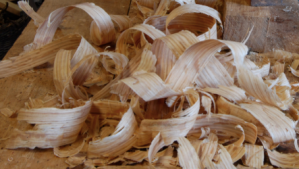
thin curls of wood
fly away
from the lathe –
his memory slips 
away bit by bit


Screen Shot 2018-08-12 at 11.46.46 AM


When you were six (tanka)


Redlights, June 2018:


when you were six
I longed to keep you
that age forever
      once upon a time
      I knew you so well


birthday candles 6


Dedicated to my son, Adam.


.

Only four . . . (two tanka)


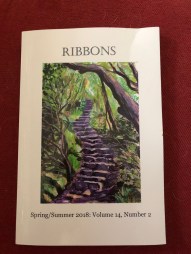
Published in Ribbons, Spring/Summer 2018: Volume 14, Number 2


the squeak

of the old swing . . .

only four when carefully taught

to keep that secret

to myself


This tanka was published in the Tanka Café of Ribbons


the little girl’s doll

marred by lipstick

scrawled on her face

. . . maybe this time 

mother will notice


IMG_0483

Condor’s Wings … (haiku)


Frogpond 2018 Volume 41 Number 2 (Haiku Society of America


the vastness

of a Condor’s Wings

Grand Canyon


Mary Kendall


California Condor at the Grand Canyon


Twisted in shame … (two tanka)


Skylark Tanka Journal 6:1, Summer 2018:

Two tanka


old walking stick—

once it was

a branch

that stretched

to the sky


              . . .


all those years spent

twisted in shame –

cultivating old world roses

but still ignoring          

the thorns


A beautiful walking stick made in the traditional manner.

Battered boards … (haiga)


battered boards

This Haiga was published in Prune Juice, A Journal of Senryu, Kyoka, 
Haibun and Haiga, Issue 23, November 2017

Note on the photo: In 2013 I visited Avignon, France, which is where this picture was taken of the outside of the Palais des Papes. It dates back to the 14th century.

Faded numbers… (haiku)


faded numbers
tattooed on your arm
I slip back in silence
.

~Mary Kendall~


Published in Presence 58 July 2017
.
.
Back story on this tanka. In 1972 I visited friends in Israel. As a tourist, I was eager to see the historical sites, one of which was Masada, site of a group suicide where a Jewish community was surrounded by Roman soldiers. The Jews chose suicide rather than be taken as captives. As I stood high up on the hilly site with other visitors, it was very, very quiet. It was after all a sacred place. An older man stood next to me, and I happened to glance at him also looking out at where the soldiers would have been waiting, hoping to starve out the isolated Jewish community. I noticed on his arm, faded numbers–numbers, of course, indicating he’d been captive in a Concentration Camp. The poignancy of him being there has stayed with me for over forty years. Never again, please Lord, shall we do such things to our fellow men.

Both pictures are from travel sites to and in Israel. Masada is located in the Judean desert, very close to the Dead Sea. Visiting these sites is like stepping back two thousand years. I am so grateful for having had this opportunity to visit.

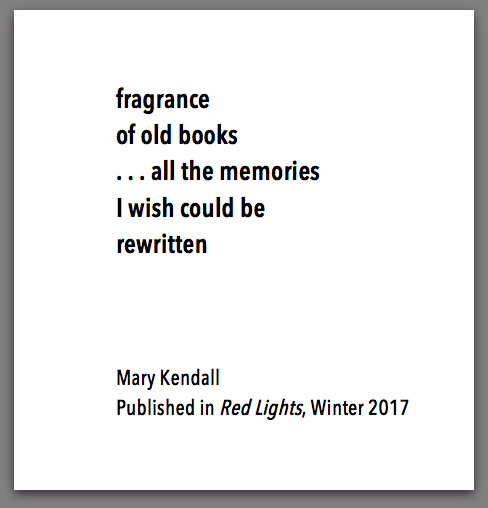
Fragrance of old books… (tanka)

Click on the link below if you care to hear me read this tanka:


fragrance-of-old-books

My thanks to editor, Marilyn Hazelton, for publishing this tanka in Red Lights, one of the best tanka journals around.

Arrowheads rise…

It is always an honor to have a tanka published in , the Journal of the Tanka Society of America. My thanks to editor David Rice for selecting this poem.


arrowheads
rise to the surface
in a newly plowed field …
old memories
can be unexpected, too


Published:

Ribbons (Journal of the Tanka Society of America), Spring/Summer 2016, Volume 12, Number 2 (page 37)


1-arrowhead 1


Charlotte’s Story: Haiku for Wilbur by Mary Kendall (ME, IN FICTION Poetry and Prose Series)

silverbirchpress's avatarSilver Birch Press

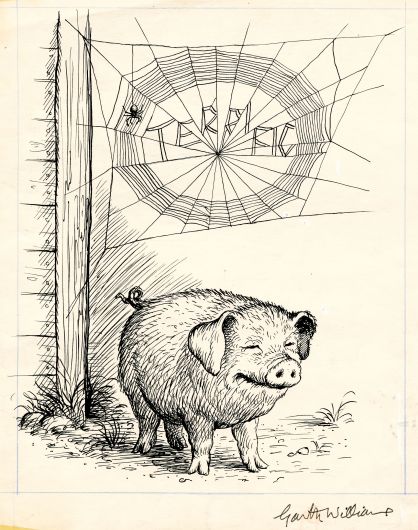
Charlottes-Web-Terrific-Garth-Williams1Charlotte’s Story: Haiku for Wilbur
by Mary Kendall

“My Words”

my words—
who knew what a story
we’d become?

“First Friend”

a friend—
something my kind
never knew

“The Unexpected”

new friend—
silken parachutes in spring wind
bestow surprises

“Silken Words”

silken words…
hearts woven together
in their own story

“Some Pig”

little did they know
how special you were—
some pig!

“Terrific”

a real friend
who accepted me as I am…
terrific!

“Radiant”

just knowing
you have a good friend…
this radiant heart

“I Told You”

out of nowhere
grows the best thing…
kindness of spirit

“Humble”

humble—
your kindness of heart
my friend

“The Fair”

harvest moon—
who knew how high
we’d fly?

“Templeton”

even a rat
can help a friend..
who knew?

“My Time”

time for rest
my voice a whisper
…alone now

“Good-bye”

no need to worry—
our memories will live on
in your heart

“Death”

View original post 261 more words

My Mother’s Voice…a poem of loss

Today, my favorite haiga was published in a favorite journal, Gnarled Oak. It is a lovely home for this haiga. Here it is along with the link to Gnarled Oak (check out all the great poetry in this journal). The editor, James Brush, releases one poem a day, a custom I love. It’s always a joy to see what each day holds. My thanks goes to James for accepting this piece.

My Mother’s Voice


My Mother's Voice haiga


.

beautiful border for blog


This haiga was originally posted on this blog on June 14, 2015.

The Mutability of Memory

All of us have memories. Good memories. Bad memories. Memories we love to revisit over and over. Memories we push far back, hoping they will disappear. Some memories are vivid, while others are dreamy and vague. A few are very, very real as if they just happened, but others feel as if they stories that happened to someone else rather than us.

Memories can be haunting. Memories can be triggered by all sorts of things—from a taste that evokes brilliant memories from early childhood to a scent of burning leaves that reminds us of an autumn long gone.

It began with a prompt in March 2014 in Poets Online to use a first line from an Emily Dickinson poem as our own poem title and then to write a new poem. This was one of my favorite prompts because it asked me to do something I had never considered. I do read Emily Dickinson’s poetry from time to time. I puzzle over her words and meanings. I spend a fair amount of time thinking about what she meant and how she did it. She never ceases to amaze me or probably any of her readers. To borrow a first line from her seemed a bit like stealing something sacred. And then the fun began–going through all of her first lines (which, of course, have also become the titles of her otherwise untitled poems)–and selecting one to work with. The prompt suggested we not read (or reread if we had read the poem a while back) Emily Dickinson’s version until our own version was complete. Fair enough.

After going through the list of first lines of Dickinson, I had to eliminate all those I knew. That meant excluding some wonderful poems I knew and loved. It also meant I had to find a poem that was unknown to me. Oddly enough the one I ended up with is a well-known poem of hers, but I couldn’t remember reading it (failure of memory on my part perhaps?), so I chose it. I love this line. “The Past is Such a Curious Creature.” Don’t you love the very idea of it, calling the past a curious creature, personification with such crisp alliteration?

Following the instructions, I did some thinking of what the line meant to me, what it brought forward. That’s how poets work. It can be rather vague to those who don’t write, but all poets know that a simple line can bring to life so many things. A poem comes from someplace deep inside, a place we’d love to explore but we only get glimpses of it. It took me a while to write the poem and to rewrite it. I wasn’t sure I wanted to submit it for quite some time. I even tested out a few other lines as prompts, but I returned to this irresistible line that Dickinson wrote. Here is the poem I finished and submitted. When the final poems were published, it was fun to read all of them. The other writers did a wonderful job. Some wrote in a style resembling hers. A few wrote in rhyme. I did none of that. Mine was in free verse, dictated only by the ideas and images that spilled out.

My poem:

THE PAST IS SUCH A CURIOUS CREATURE  (Line taken from Dickinson’s Poem CXXVII)

The past is such a curious creature
capable of creating such marvelous lies
that we begin to believe as we hear them
said again and again, forgetting that
there are those who love to distort
the truth and let it spill out and break
into brittle bits & pieces that are left
on the street to be kicked and crushed
until the shards are too small to see.

The past writes a story of its own choosing.
Its pen might be inked in faulty memory;
its paper might be marked in things that
did happen as well as those that did not.

This story is examined with the lens
of exaggeration and embellishment
until the tale that remains
is now so embedded in our minds
that we can no longer know
what was real and what was not.

And now for the inspiration piece, the poem written by Miss Dickinson:

THE PAST IS SUCH A CURIOUS CREATURE  (Poem CXXVII)
by Emily Dickinson (Complete Poems, 1924).

Part One: Life CXXVIII

The Past is such a curious creature
To look her in the face,
A transport may receipt us
Or a Disgrace.

.
Unarmed if any meet her,
I charge him fly!
Her faded ammunition
Might yet reply!

Although the prompt suggested reading the original poem after our own was nearly complete and then comparing where we were going, I opted to read Emily Dickinson’s only after my poem was more or less complete.

In Emily Dickinson’s poem, her personification of the past as a feminine being is a surprise. Then she tells us that as we remember the past, it might reveal a hidden delight or a remembrance of something disgraceful or shameful. That said, she moves to the second stanza and urges the reader to be aware that if the past memories are ignored, there might be consequences that would take us with surprising force. How true. Memories that are suppressed can and just might tumble out to reveal an unfathomable nightmare. Or more.

My own poem chose a different path. It opted for examining the past by questioning the mutability of memory. Is the past always the past? Is it constant? Or is its story one that changes in the retelling and perspective of the storyteller? My point of view came arose from the self-examination of a few haunting memories from my own early childhood. These particular memories were negative, but they were mine as I perceived them.

In asking one of my sisters about her perception of these same events, her memory was quite different from my own. So, which was true? Either one? Both? True for her, and true for me, even with different observations and conclusions? I spent a long time trying to figure it out but was unable to do so. My past. Her past. Our past. Memory can change and distort with time, age, experiences, contemplation, It does present some good leads for poems, but it does not answer the question as to what that unhappy childhood memory really was all about.

Poetry allows us to raise questions and to examine possibilities. It is not psychotherapy, nor is it scientific. What it does do is give the poet a way to explore personal stories and experiences and to turn them into something that goes far beyond the individual self. It offers each reader a chance to follow along and even to join in, adding their own experiences and memories into the mix.

What do YOU think about the mutability of memory? Can we ever answer all of the questions we have about the past?
.

.
(Note: part of this posting appeared on my other blog, Bedford Square +2)

Almost Surrendered: On Being and Nothingness ~ An Ekphrastic Poem


So, what IS ekphrastic writing or art?

As many of you know, I love art. I love going to art museums, galleries and art shows. Art history has always been one of my passions, so it’s natural enough that ekphrastic art and writing has captured my interest. A very simple definition of ekphrastic poetry is writing a poem in response to a work of art. It can be descriptive or it can be a response of any sort to the piece. There are no restrictions, no limits, and that by itself is something that has great appeal. The same goes in reverse–an artist might create a piece in response to a written work. My own blog has poems written about ancient Greek mythology, and in each posting I’ve included beautiful works of art that are ekphrastic responses to the myths.

This particular poem was a response to a show of the artwork of Ronna S. Harris that was held at the Turchin Art Center at Appalachian State University in Boone, North Carolina. My husband and I fell in love with her work and this particular painting has haunted me for nine years. This poem is my response to it. My thanks to the artist for her permission to use this painting here and in the journal it was recently published in. I hope some of you will wander over to her own website to look at the gallery of paintings she has there. I still dream of owning one of her works of art.  Her website:  http://www.ronnaharris.com


Note:  My thanks to editor Lorette C. Luzajic for publishing this poem on September 13, 2015 in Ekphrastic: writing and art on art and writing:

http://www.ekphrastic.net/ekphrastic/almost-surrendered-on-being-and-nothingness-by-mary-kendall


small Almost Surrendered

Painting:  Almost Surrendered, by Rhonna S. Harris, 1992.
Picture used with permission of the artist.


Click the link below if you’d like to hear me read this poem. It takes a few seconds to load.


Almost Surrendered: On Being and Nothingness                                                  


The gallery was empty, the artist unknown to us.
Strangers to her work, we walked in quietly,
speaking in whispers about the way she painted
a rich purple aubergine or the clear, shimmering water
in blown-glass bottles. Illusion so real it was perfect.
Her paintings seemed direct but insinuated that
something might be hidden just beyond our view.

From fruits and windows, vegetables and doorways,
suddenly there was a room full of large paintings of figures,
mostly nudes with evocative names like “Pieta” or
“Architecture of the Perfect Man.”

We stopped in front of one called “The Marriage.
It showed two figures lost in thought, in separate worlds.
It reminded me of what marriage is like for some after
so many years together. Still, silence doesn’t always speak
of distance but of an understanding of hearts.

And there, on the left wall, was “Almost Surrendered.”
A pale naked woman with arms by her side, palms stretched up
in prayer or supplication. She was translucent, existing half here,
half there. Behind her was a closed window. She wore a gold chain.

Was she a memory, a body giving way to death or being reborn?
Or was this ghostly surrender all illusion, a message
to women who have given too much of themselves?
A woman who had lost herself in trying to be everything.

Could she be a dream?

You moved on to the next picture and then the next,
but I stood there staring at this vanishing woman and
wondered who it was who really had surrendered.

Was she any woman?

Could she be me?

You reappeared, and together we moved on.
This time round, I found myself thinking about windows
in pictures, of what lay beyond the glass the artist
drew, surrendering myself to what she didn’t show,
what she concealed in her mind like a stage curtain pulled back
just enough to hint that maybe others stood on the other
side, looking back at us from a completely different angle.

Would they study us closely, marveling at our verisimilitude?
the lovely glazes of color so skillfully applied, built up so
carefully to a level of opacity that suggested real inner depth?

Would they compare us to the other figures in the gallery
and wonder why we were not painted as a man and a woman
fading from view, surrendering to a love spoken in silence?


(c) The Guardian

(c) The Guardian

June Haiku 2

weathered wood—

memories of youth

drifting away


Old Boat ~ Photograph by Mike Keville, (c) 2015

Old Boat ~ Photograph by Mike Keville, (c) 2015

The theme of old, worn wood (see June Haiku 1) continues in this poem. Amazing how beautiful things retain their magic despite age.

My thanks to photographer, Mike Keville, for allowing me to use his gorgeous boat photograph for this haiku. The textures and colours of this photo inspire many poems.

Dining with the Woodpeckers

pileated suet

While visiting my brother and his wife this summer in East Aurora, New York, we experienced a truly wonderful and unexpected visit from three pileated woodpeckers at the suet feeder Jim had filled. His wife, Paulett, said the woodpeckers were frequent visitors to their lovely back garden. This was a first for me. Although I’ve been an on again, off again birdwatcher for most of my adult life, I’ve only seen one pileated woodpecker in person before. Seeing three at the same time was simply brilliant. Watching their acrobatics as they fed on the suet, flew back and forth to peck at a tree, and generally manoeuvered their rather large bodies in amazinglying agile ways was pure delight. After a feeding frenzy, they flew away and it felt amazingly still and empty where they had been. Much like a visit with beloved family and friends, the ‘after’ part comes all too soon and leaves a void in our hearts. This poem is dedicated to Jim and Paulett, two of the kindest and most caring people I know. Thank you for sharing your home, your family and your amazing woodpeckers with us.

pileated 5

Dining with the Woodpeckers

In the late August garden
The quiet afternoon now

Comes to a languorous close.
Out of nowhere, a flash of red,

Bright scarlet crests crowning
Zebra-patterned feathers.

Three Pileated woodpeckers
Begin to feast at the suet feeder,

Fluttering, flying tree to tree,
Tree to feeder, alternately

Pecking at thick maple bark,
Then shifting to soft silky suet.

The youngest, now the size of its parents,
Joins in to grab his share, and father

And mother dutifully give way.
For a few Cirque des Oiseaux moments

All three woodpeckers hang right side up
And upside down, their brilliant red heads

Flash like stop lights in the early evening sun.
We sit around the table eating an early supper

And sipping local wine. Conversation drifts
As we watch in these avian acrobatics.

Just as quickly as they arrived, so soon are
They are gone. More wine is poured,

Seconds of hot buttered corn and fresh
Heirloom garden tomatoes are passed

From one to the other. Like the birds,
We share this meal together, enjoying

The richness of what the day has given.
A light wind blows the leaves outside,

A beautiful evening for us to be together
Knowing that summer will end all too soon.

Picture by Beth Brandkamp

Picture by Beth Brandkamp

When a Heart Breaks

I’m not sure where this poem came from. It just happened. I was thinking about the sad loss of butterflies this summer and what that might mean to our environment, our gardens, our enjoyment of nature. Somehow, from that line of thought to the poem…well, how does one explain where things are born? I hope you enjoy this poem.

An audio of me reading this poem is available at the link below. Give it a few seconds to begin.


unraveled heart

When a Heart Breaks


Did you ever consider a heart is like a chrysalis?
Perfectly wrapped round and round, silken strands
layered one upon the other, locked together
in a solid embrace of fragile fibers.

This is what the heart is.

When a heart breaks, no one picks through
the fibers trying to separate the strands.
Yet it can be undone so easily.

Words can unravel it so quickly that it spins
like a frenzied top, leaving behind a trail
of weakened strings, no longer useful to anyone.

Icarus II (Poetry and Myth)

feather-lake-russia_71645_990x742

Swan Feather, Moscow by Veronika K. Ko (c) 2013

If you care to listen to me read the poem, just click on the link below and wait a few seconds for it to begin:


Icarus II

The hardest part was letting you go,
knowing  that once you sailed so high
it would be impossible not to try again.

With each pass you made, you soared
higher, more effortlessly; sweet-scented
beeswax noticeable as the air grew warmer.

Arms outstretched as if embracing the sun,
you changed course and flew even closer
before you shifted abruptly, a quick turning

of wings, now fighting the unexpected wind
with young muscles tensed and determined
to hold the course.

The descent was swift.
A feather fell
and then another.

Daybreak (2)


Yes, this is the second time you’ve seen this picture in my blog. It was posted with a poem, Daybreak, in late August and now it reappears to accompany a second poem it also inspired, Daybreak II. A single picture on paper, on the screen or in the memory has a powerful, persuasive control of our imagination. This beautiful photo by my friend and photographer, Yolanda Litton, has done just that.


Early Morning at Bagnegrole (Photograph by Yolanda Litton)

Early Morning at Bagnegrole (Photograph by Yolanda Litton)

I’ve included an audio clip of me reading the poem. Click on the link below and wait a few seconds.


Daybreak  (2)


Waking up in at daybreak in the south of France
Is as if I were stepping into someone else’s life.

So far from my own home, this wistful morning fog
Rises slowly to reveal a house of soft honeyed stone.

The slope of a sharply pitched roof holds a tall chimney
Where the swifts are now resting after a long evening hunt.

Somewhere a rooster crows with the energy that only
The young can bring to a new day. Out of nowhere,

A soft gray cat tip-toes by, looks up at me and blinks
Its eyes in that inscrutable feline way and disappears.

I stand here leaning on the windowsill, wondering
What my life would be like had I been born here.

The smell of freshly brewed coffee wafts up from
The kitchen below. One lone church bell rings

Calling its faithful to prayer. But nature’s beauty
Is my religion, my serenity, my salvation, my Eden.


An Autumn Long Gone ~ a Reverie

An Autumn Long Gone ~ a Reverie  (prose poem)


An audio of me reading this prose poem can be heard by clicking the link below. It will take a few seconds for the sound to begin.


It was the year we lived in London, some 25 years ago, when autumn began like any other autumn. The fall, the changing, the color shifting, the soft breezes, the sporadic thick fog and the leaves dancing, even floating upward at times. What I hadn’t anticipated, being so far north for the first time, was how short the days grew. How dark it became earlier and earlier all during that autumn. The days were ‘closing in.’ That’s what they called it, and I loved that phrase. It brought a certain comfort of pulling heavy curtains closed and shutting out the darkness. It was a time for wearing coats and warm sweaters, and I dressed my son in practical English clothing and soft grey mittens while he ran ahead enjoying what was left of the day. He was only three, but he knew the delight in using what was left of the day’s sunlight. I learned to enjoy the simple pleasures around me that came with this quiet season. Victoria plums were my new delight. They appeared at the Greengrocer’s shop just as autumn set in, later replaced by apples—Bramley and Cox’s Orange Pippins, names that twirled on the tongue and tasted as good. Burning leaves were an unexpected, half-loved sensory pleasure. The smoke was pungent, but it brought back memories of childhood. I loved even the rasp of raking, bamboo or metal combs gathering leaves in sacred piles waiting their turn to be sacrificed in an autumnal pyre. In the English light, I found the colors were softer, quieter than the brilliance of New England woodlands. Each morning I left my son at school and then walked through Hampstead Heath. I found my own favorite route through woods and meadows up to the large ponds. Purchasing a single cup of tea that warmed my hands, I made my way to that empty bench that faced the pond. I thought about all the people it had held before. And every day without fail a lone Scottish piper played his bagpipes as if on cue. Each day I sat and listened. A world so far from my own. From where he stood near the peak of Parliament Hill, the mournful songs became a wordless chanting, charging the air with a lamentation to this closing season, every day briefer, softer than the day before.

Lost in Reverie (c) 2014 by Isotel, The Obvious and Hidden blog on WordPress (with her permission)

Lost in Reverie (c) 2014 by Iosatel, The Obvious and Hidden blog on WordPress (with his permission)

Four Autumn Haiku


Today is the first day of autumn, and for my writing practice in the next few weeks I’ll begin a series of autumn or fall poems. This is my favorite season, my soul season. I’ve done a few different types of haiku ranging from traditional 17 syllables to a poem in a single line. Do you have a favorite?

1.

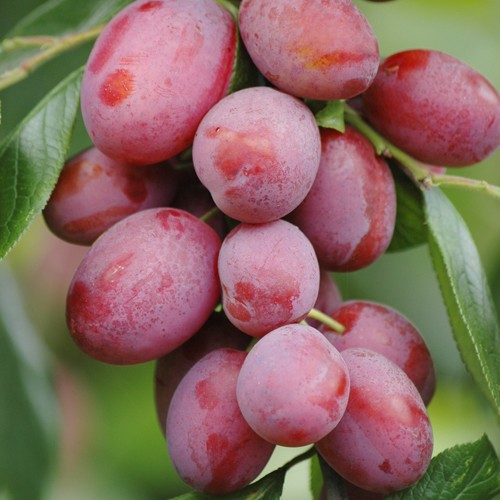
biting into a Victoria plum, such guilty pleasure

253871

2.

spent blossoms–
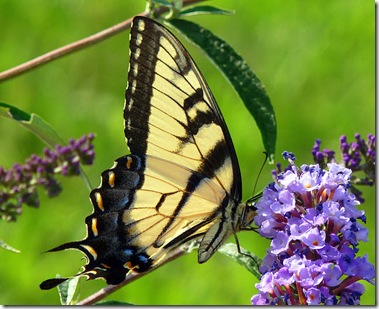
the last swallowtail
sips alone

best swallowtail pic

3.

soup 1

the season’s first soup
almost ritually cooked
stirs our senses

4.

sweet windfall apples…
bruised memories
autumn of long ago

fallen apples

Modern English language haiku are not always seventeen syllables. A haiku can be many things, but always it is a brief poem with a strong image that evokes a season and a moment of time captured simply in lyrical language. Scroll to the bottom of today’s blog to find a list of essential qualities of haiku.

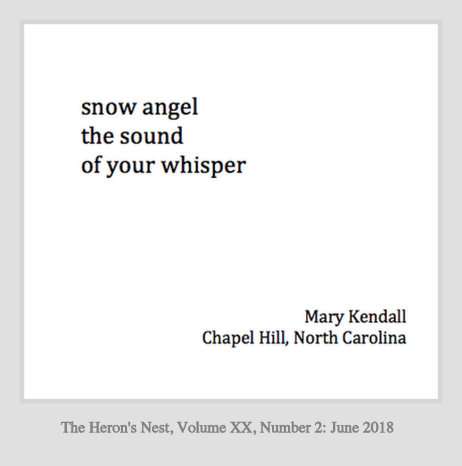
The following list from the wonderful journal, Heron’s Nest, lists important qualities that make a haiku.

 Here are some qualities we find essential to haiku:

  • Present moment magnified (immediacy of emotion)
  • Interpenetrating the source of inspiration (no space between observer and observed)
  • Simple, uncomplicated images
  • Common language
  • Finding the extraordinary in “ordinary” things
  • Implication through objective presentation, not explanation: appeal to intuition, not intellect
  • Human presence is fine if presented as an archetypical, harmonious part of nature (human nature should blend in with the rest of nature rather than dominate the forefront)
  • Humor is fine, if in keeping with “karumi” (lightness) – nothing overly clever, cynical, comic, or raucous
  • Musical sensitivity to language (effective use of rhythm and lyricism)
  • Feeling of a particular place within the cycle of seasons

Back to Edinburgh

Back to Edinburgh
 Here is my reading of the poem, Back to Edinburgh:


 Back to Edinburgh

We walk through the hidden streets of this city,
The second day of spring and the wind gusts hard.
People stop and wince, cupping their ears for warmth.
The news said blustery winds up to 25 mph,
And
it feels as if we might tumble down the street.

Looking for simple woolen hats to pull down
Over our frigid heads, we stop at a Royal Mile shop. 

I select gray, and you opt for black. I am grateful
That your good felt hat is safe back at the hotel.

The street is so rich in history that it feels as if
It could reach out and grab us by the arms,
Pulling us down a small wynd or narrow close
That has
 a story to share,

And in the late afternoon gloaming,
We might be wind swept and turned around
Into some other time.

It could happen you know.