I recently had one tanka published in Skylark: A Tanka Journal. I’m thrilled to have a poem selected for publication by Claire Everett, the editor. She is one of the world’s foremost tanka poets and one whose work I love and admire.



This haiku has just appeared in The Heron’s Nest, a distinguished journal of haiku. For me, as a first time poet in this journal, it is a truly great honor for which I’m thankful.
My poem is on page 11 of The Heron’s Nest: http://www.theheronsnest.com/March2016/haiku-p11.html
winter night—
the curl of woodsmoke
takes flight

I hope some of you will click the link to The Heron’s Nest to read the full issue of wonderful haiku from around the world.

Note: photo is in the public domain (found linked with many sources online)

This tanka art piece is the second in my Dream Time series of poems. To read the first poem in the series (on this blog), follow this link:
As you’ll notice the two poems are quite different in style and content, but I’ve grouped them together in Dream Time since both were written while poised on that slender edge of dreaming into another time and place.
A Special Word of Thanks:
A big thank you to my dear husband, Ritchie D. Kendall, who took this photograph on a hill in Greenwich in 2013 when we were living in London.
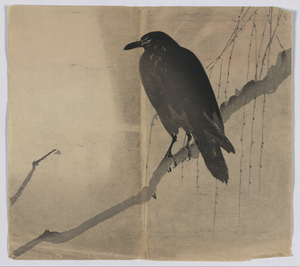
Crow on a Willow Branch, Japanese woodprint, Library of Congress woodprint
In my last posting here, I put up a new haiga that was just published in cattails, January 2016, the journal of the United Haiku and Tanka Society, but I was really very fortunate this time round in having three other poems published in the same issue: a haiku, a senryu, and a tanka.
cattails, January 2016, haiku, p. 8:
winter—
each day closing in
on itself
cattails, January 2016, tanka, p. 4:
chased away
by a gang of crows
the red-tailed hawk—
being different
is never easy
cattails, January 2016, senryu, p. 9:
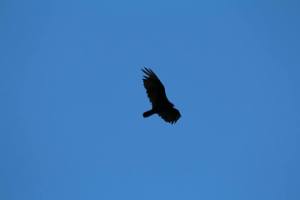
black Friday—
the vultures circle
round and round
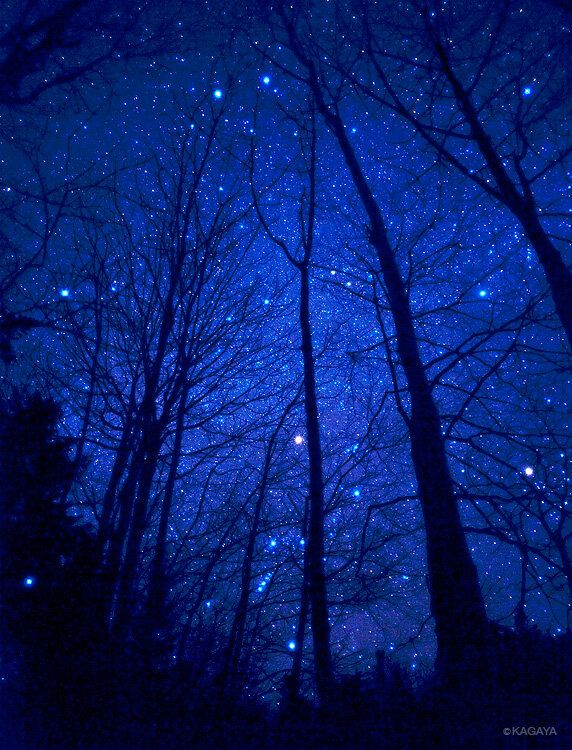
Starry Sky (c) Kayaga
how could the moon
show its face
without light
…how could the stars
sing us songs?


New Note as of March 11, 2016: This poem has just been published on a favorite online journal called Ekphrastic: Writing and Art on Art and Writing. A link to the journal: http://www.ekphrastic.net/ekphrastic/beauty-in-broken-pieces-by-mary-kendall
~ ~ ~
Readers of this blog don’t always notice its subtitle: One Poet’s Practice. I like to practice. I like to experiment. All poets do. Without stretching the mind, you fall into the pattern of repetition. Each poem starts sounding like the last or the next.
I have been writing a lot in short form poetry–haiku, haiga, tanka, and other small poems. Today, in an effort to go in a completely different direction, I offer you a very long, rambling poem–quite unlike me, I know. It is called “Beauty in Broken Pieces,” inspired by a lovely photograph taken in Dublin, Ireland by India Leigh Lassiter, herself a talented writer as well as photographer. Thank you, India, for allowing me to use your picture as a starting point for this poem.
To hear me read this poem, please click on the link below (give it a minute to load):

Blue Spiral, Dublin, Ireland (c) 2015 photograph by India Leigh Lassiter
Beauty in Broken Pieces…
Perhaps it was once a deep blue vase,
holding seven pale pink peonies
freshly cut one May morning…
the silence shattered
suddenly when
she lost her balance,
grabbed
the oval table
and together
crashed down,
one in splintered pieces,
the other dazed
watching the water
slowly spread
under the petals.
Or perhaps…
it was packed away in a doctor’s study,
an old cabinet filled with bottles…
cobalt blue bottles with faded labels,
the dark blue hinting of hidden secrets,
dangers that lay in long-dried residue
of those bottles that were shattered
and thrown upon a fire
that raged for hours,
flaring up in vivid hues
of acid green
and mustard yellow,
tipped with amber,
azure and moon,
the air once heavy
with poison
and dreams.
Or…maybe
there was no story.
Do you believe the whole really is bigger
than the sum of its parts?
And please, don’t let’s forget
there is always
perspective.
Large things are large,
but small things
are also large
if seen
close
up.
It is lovely, this small mosaic
made of glass in shades of blue,
blue so dark,
it might still hold the sound
of the ocean from the sand
that washed up and back
over and over
dancing on the ocean floor
before it became
the glass
we see…
for what is glass
but sand
and fire,
beach
and
star?
even
a simple
spiral
mosaic
in shades
of blue, pearl and silver
might hold the deep bass song
of the darkling ocean,
the glimmering
whispers
of clouds
above,
patterns spiraling through nature
like our thoughts about beauty,
reality or memory’s truth
Fibonacci gave it his name,
the Greeks gave it meaning
with their golden ratio…
it exists everywhere
… a simple nautilus shell,
the sunflower’s seed head
that turns to the sun,
and following its cue, the pinecone,
the hurricane, even the galaxy, the cosmos
and here with this Irish glass spiral
we come full circle of woman
with camera, snapping
a photo, capturing
the balance of
silvery bits
and pearl
to blue
done
just
so
.

goniatite-fossil
 A Poet in Time