I recently had one tanka published in Skylark: A Tanka Journal. I’m thrilled to have a poem selected for publication by Claire Everett, the editor. She is one of the world’s foremost tanka poets and one whose work I love and admire.


Two tanka and one haiku were published
in A Hundred Gourds 5:2 March 2016

~~~
A Hundred Gourds 5:2 March 2016
http://www.ahundredgourds.com

Haiga by Mary Kendall
This was written for a prompt on the spring equinox for a favorite small poem poetry group I belong to called “seize the poem.” I’m enjoying creating this mix of haiku and photography, and I think I finally got the words correctly balanced on the picture, so I’m sharing it here as well. The photo is my own taken in the sculpture garden of the Rodin Museum in Paris this month.

~ ~
I’m still very new as a haiku poet, so it is with caution that I’ve ventured out to try an actual haiga. A haiga combines art and a haiku. Since I lack all painterly skills, I’m combining my haiku with a photo that I love. I’ve done this in a slightly similar way on my blog with tanka and some autumn haiku. However, I consider this to be my very first true haiga.
~~
“Haiga is a Japanese concept for simple pictures combined with poetry, usually meaning haiku. In Basho’s time, haiga meant a brushed ink drawing combined with one of his single poems handwritten as part of the picture. In our day and age, haiga can be watercolor paintings, photographs or collages with a poem of any genre that is integrated into the composition. Sometimes the poem is handwritten or it can be computer generated, depending on the artist’s taste.” (This definition of haiga is by the poet, Jane Reichhold on her website, Ah Ha! Poetry.)
~~
Note on Photograph:
This beautiful photograph is by an Icelandic photographer known to me only as KariK on Flickr. It was posted and thus copyrighted in (c) 2011. It has been posted thousands of times online and almost never with an attribution to him. By doing a ‘backward’ image search I was able to find him on flickr. His photographs, most of nature, are magnificent. This is what he wrote for this particular picture (translated from Icelandic):
Reykjanestá: This location is unique for the fact that there can see the ocean ridge walk on 1 and, Mid-Atlantic Ridge, which separates the prefabricated North America and Europe.
KariK, (c) 2011
Wild Water: Three Tanka
1.
throughout the long day
the wild water crashes
again and again—
memories of you silently
slip under water
2.
as evening comes
the tide begins to swell
in the empty sound,
one lone boat
longing to set sail
3.
foghorn rasping
deep and low—
a bleak song
of ships surrendering
to savage waves

While visiting my brother and his wife this summer in East Aurora, New York, we experienced a truly wonderful and unexpected visit from three pileated woodpeckers at the suet feeder Jim had filled. His wife, Paulett, said the woodpeckers were frequent visitors to their lovely back garden. This was a first for me. Although I’ve been an on again, off again birdwatcher for most of my adult life, I’ve only seen one pileated woodpecker in person before. Seeing three at the same time was simply brilliant. Watching their acrobatics as they fed on the suet, flew back and forth to peck at a tree, and generally manoeuvered their rather large bodies in amazinglying agile ways was pure delight. After a feeding frenzy, they flew away and it felt amazingly still and empty where they had been. Much like a visit with beloved family and friends, the ‘after’ part comes all too soon and leaves a void in our hearts. This poem is dedicated to Jim and Paulett, two of the kindest and most caring people I know. Thank you for sharing your home, your family and your amazing woodpeckers with us.

Dining with the Woodpeckers
In the late August garden
The quiet afternoon now
Comes to a languorous close.
Out of nowhere, a flash of red,
Bright scarlet crests crowning
Zebra-patterned feathers.
Three Pileated woodpeckers
Begin to feast at the suet feeder,
Fluttering, flying tree to tree,
Tree to feeder, alternately
Pecking at thick maple bark,
Then shifting to soft silky suet.
The youngest, now the size of its parents,
Joins in to grab his share, and father
And mother dutifully give way.
For a few Cirque des Oiseaux moments
All three woodpeckers hang right side up
And upside down, their brilliant red heads
Flash like stop lights in the early evening sun.
We sit around the table eating an early supper
And sipping local wine. Conversation drifts
As we watch in these avian acrobatics.
Just as quickly as they arrived, so soon are
They are gone. More wine is poured,
Seconds of hot buttered corn and fresh
Heirloom garden tomatoes are passed
From one to the other. Like the birds,
We share this meal together, enjoying
The richness of what the day has given.
A light wind blows the leaves outside,
A beautiful evening for us to be together
Knowing that summer will end all too soon.

Picture by Beth Brandkamp
The First Coyote
Shadowed by trees, it was alert,
Watching those on the porch.
Tall, thin, a knife sharp gaze,
This coyote knew its way around.
The startled man cradled the cat
And called the nervous dogs back
Inside the house, far away from
This lurker in the evening woods.
Was it waiting for a squirrel or
Rabbit? You couldn’t tell this far
Away, yet clearly it was patient
And after tonight’s dinner.
How else could it survive
If not for foraging here and
There, waiting for a quick
Capture, meat for a day or two.
This was the first coyote seen
In the neighborhood, and now
I open the window late at night
To listen to it sing to the moon.
I have included an audio clip of me reading the poem, Daybreak. To hear it, simply click on the link below and wait a few seconds for it to begin.

Early Morning at Bagnegrole (Photograph by Yolanda Litton)
Daybreak
The garden at daybreak.
Before the sun dares
to unveil the dawn.
Clouds and birds.
Dew glimmering
on grass.
Stillness.
Blurred trail of bats
filing into the attic
for rest.
Clouds bloom.
Birds now singing.
Morning shadows lead the way.

My thanks to friend and photographer, Yolanda Litton, for her beautiful photograph from the south of France. Seeing it inspired this poem after bringing back memories of my own travel to Provence.

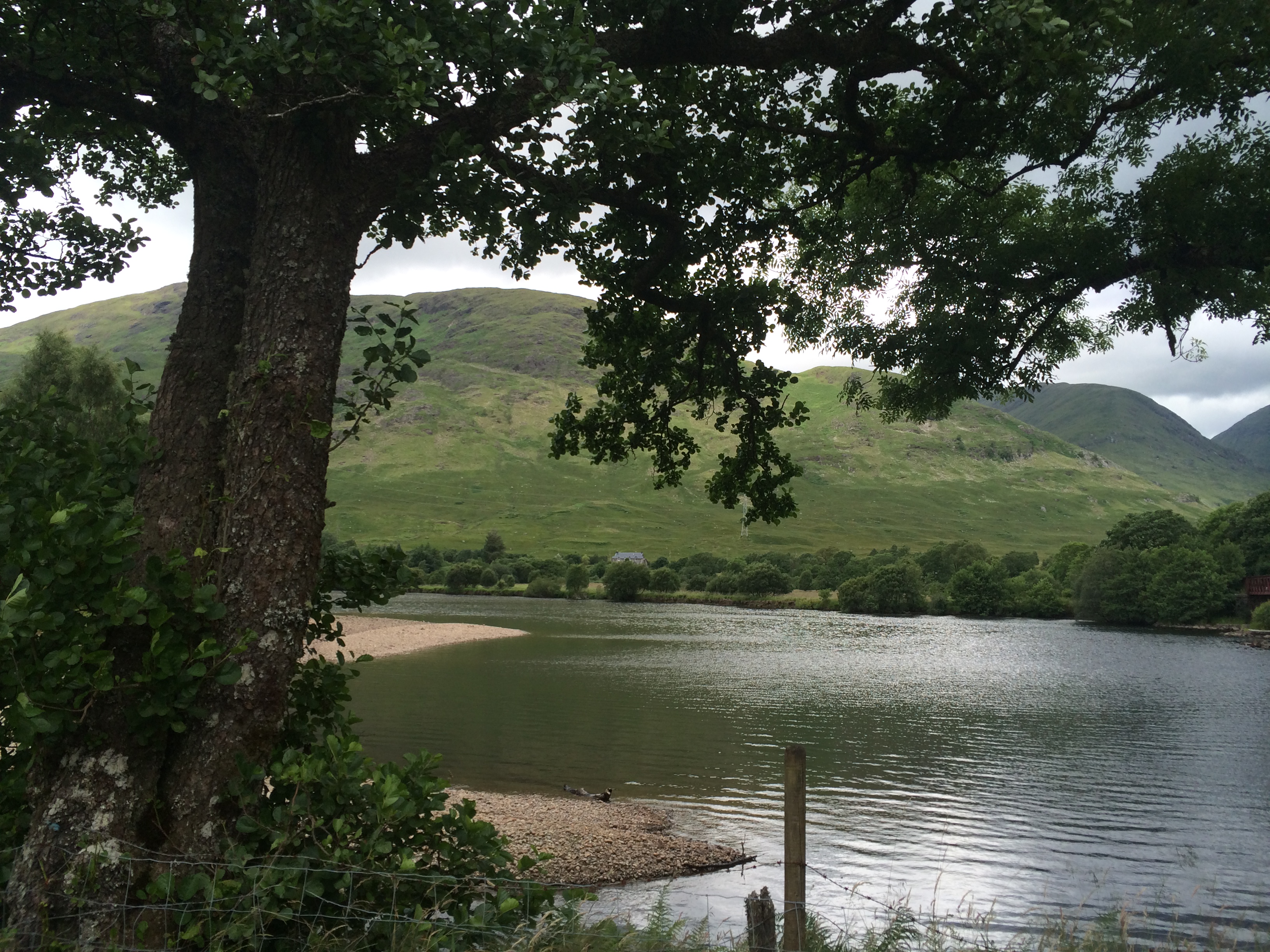
This poem began in a meadow up in the Scottish Highlands while my husband and I were visiting the ruins of a castle. He went inside to explore further, but I chose to stay behind and linger in the beautiful summer fields. As you have probably experienced yourself, this frequently leads the imagination to so many new places. It also presents an opportunity for a simple sensory awareness meditation. Just standing there looking and listening is a spiritual act in itself.
The challenge for me in this poem was to use a repeating word (“listen”) to create both mood and cadence in the lines. The decision to complete the poem with a repeating line (or couplet) was a very different way to close my own lyrical love song to nature.
[Note: the following two paragraphs were added here several months later when the poem was published by Dagda Publishing Company.]
On 3 March 2015, Dagda Publishing Company, a publisher of poetry and literature based in Nottingham, UK, featured this poem in their blog. It was a real honor to have had my poem chosen by this excellent publisher. This is what they had to say about the poem:
Today’s featured poem, and the first one in March, is this one from Mary Kendall. Inspired by a trip to Scotland, this piece has a naturalistic theme to it, and we feel is just perfect for this time of year, as we start to escape the cold and dark of winter and crawl toward summer and longer days. Musing upon the sounds of nature and imagining a song being sung by the choir of trees, flowers and the meadow itself, this piece has a touch of magical realism to it, of there being something fantastical just behind the ordinary and everyday. A poem full of the wonder of nature and the sense of being away from the familiarity of one’s normal life, we hope you enjoy this poem by Mary Kendall.

An audio clip of me reading this poem is included below. Click on the link below to hear it. It will take a few seconds to begin.
Meadow Song
Have you ever been a few thousand miles from somewhere,
standing in meadow of sweet grass or barley and thistles,
bright pink bells of foxglove swaying in the wind,
and then you stop, just standing still and listening;
listening to the wind song of the leaves and grasses.
I asked them to tell me the words they sang to those
who stopped to listen. They heard me and replied,
but I could not understand what it was they said.
I waited and waited until the wind resumed its blowing,
the grasses their gentle whispering;
the leaves sang loudest of all, and I listened.
I listened the while.
I listened until the song ended,
and then I went on my way.
So far from home.
So far from home.