Walking Away

Where do poems come from? Anyone who writes poetry asks that question and has that question asked of them by others who wonder how a poem comes to be. There are many articles and books on the subject, but still there is no single answer. Every poet writes differently and often in a lifetime writing patterns and habits might change, too.

To show you how oddly this can happen, I’ve decided to post a poem that appeared in my chapbook, Erasing the Doubt (published 2015 by Finishing Line Press). “Walking Away” is  a poem that has its own style, its own cadence and its own meaning. If I were to read this somewhere, I think I’d say it feels very much like an old fashioned poem, as if it echoes a voice from long ago. How did that happen? There is an unusual story behind this poem and how it came to be. It came to me as a whole poem when I was up late writing and suddenly became very, very tired. It appeared almost dreamlike to me. I typed it up quickly, read it once and went to bed. When I read it the next day, it didn’t feel or sound like me, but obviously I had written it. Strange indeed. This experience happened only once in my life.Was another poet speaking through me? Or was this merely a side freed from regular consciousness because of fatigue?

I’d love to hear your comments on this poem and what it means to you when you read it. Feel free to leave a message

I’ve recorded this poem if you care to listen as well as read. Just click on this link:
610980-bigthumbnail

Walking Away


When you go, where do you wander?
When you leave me, do you look back?
I sit here, book in hand, not reading.

           The wind blows fiercely through now.


They asked how long you had been silent,
And I answered with a lie, which
Was not the truth but might have been.

          The wind blows silently through now.


Did you hear me whispering to you?
Did you hear what I had to say? Or did
I turn away and only mouth the words?

          The wind blows piercingly through now.


Where do you go when you wander?
Tell me what you see. When you look
At me, I feel you walking away.

          Lamenting the darkness, the wind blows softly now.


1-IMG_1133

“Walking Away” was published in Erasing the Doubt by Mary Kendall (c) 2015, Finishing Line Press.
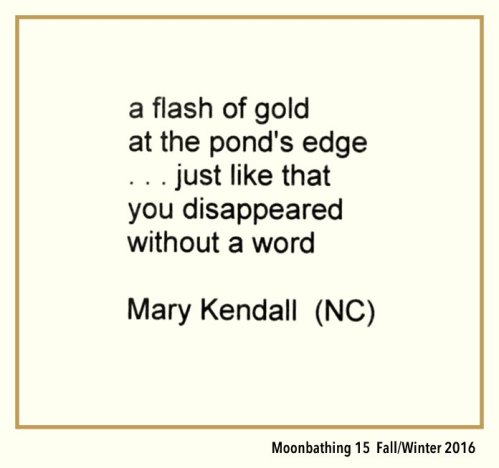


A flash of gold…(tanka)

img_2586


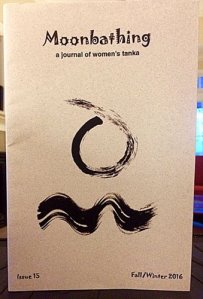
moonbathing-15


It is always an honor to have a poem appear in Moonbathing, A Journal of Women’s Tanka.
Issue 15
Fall/Winter 2016

Edited by Pamela A. Babusci

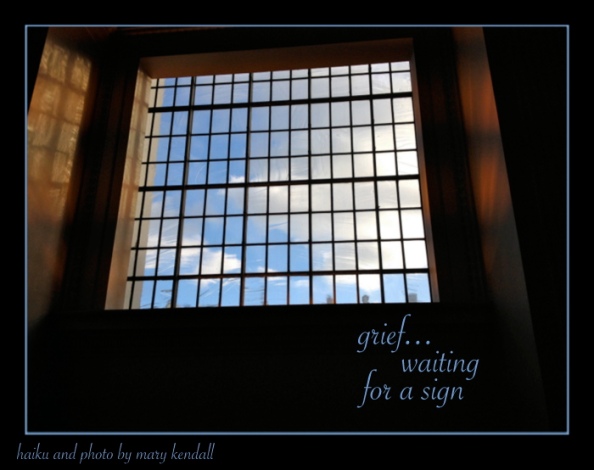
Grief (a haiga)

grief haiga kendall


Screen Shot 2016-08-31 at 11.39.35 AMThis haiga was published in Wild Plum, a haiku journal, 2:2 Fall & Winter 2016. 

My warmest thanks to the editors, Gabriel Sawicki and Maria Tomczak.


The hidden depths of sorrow

Another pairing of a tanka of mine with a stunning photography by Irena Iris Szewczyk that was published in Frameless Sky 4 (Summer 2016). I am amazed at how perfectly they matched…a big thank you to Christine L. Villa, editor of Frameless Sky for her excellent work and to Irena Iris Szewczyk for her beautiful photograph.

This link below is of me reading this tanka:


031


So many I loved now gone

In Frameless Sky 4, my tanka was set to this beautiful photograph of Irena Iris Szewczyk. My warmest thanks to Irena Iris Szewczyk and to Christine L. Villa, editor of Frameless Sky. I will be posting others from this fine video publication in the next week.

A link to me reading this tanka is given below:


071


A Few Extra Notes:

Irena Iris Szewczyk is both a distinguished photographer and haiku poet. Irina blogs at Iris Haiku where she posts her photographs and her haiku:                                           http://iris-haiku.blogspot.com

Her artwork for Frameless Sky 4 can be seen here:  http://framelesssky.weebly.com/artwork.html

Christine L. Villa is editor of Frameless Sky. She is a distinguished poet herself. Her blog is called Blossom Rain and is located here:  http://blossomrain.blogspot.com

Frameless Sky can be found here: http://framelesssky.weebly.com

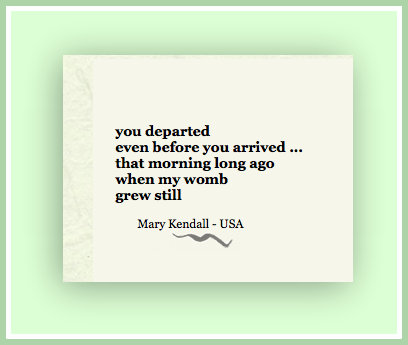
You departed…

One of the finest journals around for Japanese short form poetry has been A Hundred Gourds. The editors announced several months ago that the June issue would be the last issue. This is a great loss, but there is an amazing amount of work editors do to make a journal of this caliber work so well.  The tanka editor, Susan Constable, is one of the finest poets around, and her skill and advice as an editor is special. I know I have learned a great deal from her through our correspondence this past year. My thanks go to all the excellent editors of this journal. I am fortunate to have two tanka selected for this final issue of A Hundred Gourds. I will be posting them separately, one today and one tomorrow.


2-A Hundred Gourds 2 June 2016

A Hundred Gourds 5:3 June 2016