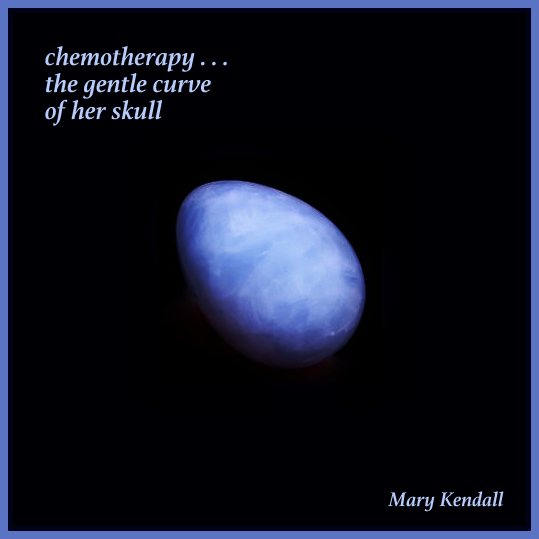
An Honorable Mention . . . (senryu)

chemotherapy


~ This poem/haiga is dedicated to all who have struggled with cancer. ~

~ ~

A wonderful surprise email told me that a haiga of mine had been selected as an “Honorable Mention, Mixed Media** Category” in the Jane Reichhold Haiga Contest sponsored by two wonderful senryu journals:

Failed Haiku, A Journal of English Senryu Volume 1, Issue 11, edited by Michael Rehling

Prune Juice – A Journal of Senryu, Kyoka, Haibun and Haiga, Issue 20, November 2016, edited by Steve Hodge

The Judges of the contest were: Kris Kondo, Ron C. Moss, Michele Root-Bernstein

Michele wrote the commentary on my haiga: 


With the sparest of words and imagery, this haiga lays bare the essence of life in the face of death. If the poem skirts the uncertain boundary between haiku and senryu, just as certainly the picture skirts the shadowlands of mortality, its single image illuminating the darkness with a pulsating light. So well integrated are text and image that the associative leap between the two has the power of metaphor: the shaved skull is the incubating egg, never mind the incongruity. Avoiding the maudlin and the sentimental, this haiga speaks simply, honestly, of the beauty to be found in the ordinary, ordinarily hidden from view.”

This competition was in honor of the late Jane Reichhold who was such a brilliant poet, teacher, editor and mentor to so many who write haiku, senryu, tanka and other small form poems. I never had the honor of meeting her, but her main book on haiku has been a bible for me and so many others.

**Mixed Media, which can be any combination of traditional and photographic, or computer generated images and text.
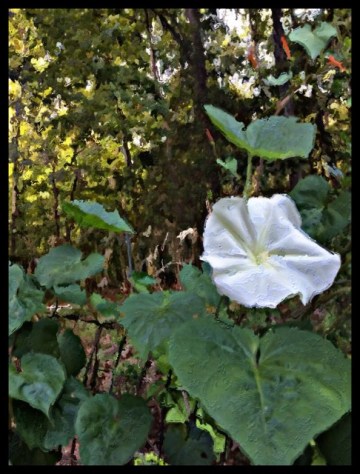


moon flowers . . . (a haiku)


Published in Brass Bell, November 2016:

1474764165030

Photo art by Mary Kendall

.

.

moon flowers –

my son shows me

how they unfurl


Tanka by Mary Kendall

What a delight to have two tanka appear on Miriam’s Well today. What an honor. Thank you, Miriam Sagan.

Miriam Sagan's avatarMiriam's Well: Poetry, Land Art, and Beyond

who am I
to judge you
without knowing
why you built
your fence?

***

words grow muted
and hearing diminished –
I begin to tiptoe
along the lonely curve
of inner silence

This tanka first appeared in Ekphrastic, a Journal of Writing and Art about Art and Writing, 9/2/16

View original post

Mask Maker

Who are we really? We can present ourself to the world in many ways, and we do. It’s been quite a while since I posted a longer poem on my blog, so today I offer you a poem called “Mask Maker.” It was written to an ekphrastic prompt on Rattle a few months back, but it was not selected. The two winning poems were brilliant and should have been chosen.

.
What’s great about writing to a good prompt is how an image can pull all sorts of ideas from us. The prompt was a picture of several sets of hands modeling in clay. I toyed with the idea for quite some time and discarded two other poems until I settled on the one that grew into this poem.


Mask Maker


Do you like this mask, the one I made

so carefully, molding it to the contours

of my face so it looks just like me?


I wear it day after day, occasionally

slipping it off and refashioning it a bit.

It changes as I change.


I was four when I made the first mask—

out of mud from the bare earth in the yard.

It blocked my fear, and hid my thoughts.


I was invisible to the world, hidden behind

this new cover. No one noticed when I wore it,

so I kept it on, and it protected me.


Once it nearly shattered during that long fall

down the stairs that he never spoke about.

Dazed, I woke up and checked the mask.


It was the one thing that hadn’t been hurt.

After that I knew I needed it to keep me safe,

to keep me quiet, to keep me out of the way.


When I closed my eyes, I could imagine it was

no longer a mask but just me, unseen by him.

It made me look like a normal girl, a good girl.


After many years and many masks, I became

quite good at molding a mask so flawlessly thin,

so delicate, transparent as a butterfly wing.


It was easy to slip on, and no one could tell

what was real and what was not, even up close.

It worked, and that’s all I ever wanted.


There is a small secret I learned from making

masks and wearing them day and night:

You must believe it’s you and not a mask.


It is you, but a different you, a you that won’t

cry out or tell secrets or even cringe too much

when unexpected blows come (and they do).


Close your eyes now. Imagine yourself this

way—in control and protected from the world,

safe from everything you fear, hidden far away


behind this lovely mask where you can watch

what’s going on, where you can be vigilant,

and where you are the real you only you can see.