A selection of haiku…

A lovely surprise today when I found out that eight haiku I wrote were published in the online journal, Under the Bashō 2016, in the Modern Haiku category. I was also fortunate enough to have two one-line haiku also published in the One Line category, plus one in the Poets’ Personal Best category.

My thanks to editors Kala Ramesh, Johannes S.H. Berg and editor-in-chief, Don Baird.


The links to the journal:

Modern Haiku category:  http://underthebasho.com/2016-issue/modern-haiku/1798-kendall,-mary.html

One Line haiku category:  http://underthebasho.com/2016-issue/one-line-haiku/1759-kendall,-mary.html

Poets’ Personal Best category:  http://underthebasho.com/2016-issue/one-line-haiku/1759-kendall,-mary.html


The poems:


Modern Haiku category:


hospice –
rubbing lotion
into her still hands


bitten nails . . . 
holding the pain
in her hands

 
worry beads –
one by one I parse
your silence

 
nightshade –
the smoothness
of an aubergine


lonely night –
even the moon
looks around


darkening forest –
a wood thrush
begins to sing


chance of a lifetime –
my finger in front
of the lens


unable to swallow
childhood memories
rise up


One Line haiku category:


lone tricycle blue in the whirlwind of leaves


burnt butter that morning in Provence


Poets’ Personal Best:


hospice . . .
a glimpse of moonlight
on the bed

                                      The Heron’s Nest – June, 2016   (originally published)


2014-11-04-12-19-00

When the Light Departs (a responsive tanka sequence)

snow-drops-public-domain-picture


Earlier this year, Australian poet and friend, David Terelinck, invited me to create a responsive tanka sequence with him. David is a poet I greatly admire, so it was a real honor to write with him. It was the first time I’d attempted anything like this, but under David’s very gentle and skilled tutelage, our sequence grew and grew. In creating this piece with David, I learned as much about trust as I did about the nuances of writing tanka.

When we finished our sequence, David asked, “Now where shall we send this sequence for publication?” I was dead silent, being a bit in shock that he felt this piece should be published. At his suggestion, we submitted it to Skylark, a Tanka Journal edited by Claire Everett.  Claire is one of the world’s finest tanka poets and editors. She herself has written responsively with David, and he has provided the forward for her last book. Two of my favorite poets alive discussing publication and minor edits. What a wonderful thing to happen.

This month, Skylark, a Tanka Journal, Volume 4, Issue 2, Winter 2016 was published.Here is our tanka sequence, When the Light Departs. My thanks to you, David Terelinck, for being my teacher, mentor and friend.

~

[Note: David’s verses are in regular font and mine are in italics.]

Responsive tanka sequence between David Terelinck (AUS) & Mary Kendall (USA)

When the Light Departs


this alloy
of clouds & winter light –
it’s not what you said
but how you looked
as you said it . . .


still unable
to explain why the world
seems darker now . . .
all the frozen buds
on the camellia bush


days and days
of endless rain that swells
the window sills –
only two weeks left
in her first trimester


a sudden
knowing of what
may never be . . .
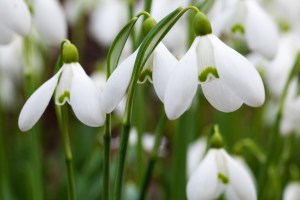
the silence of snowdrops
pooling on the lawn 


not the way
she expected to wear
all white . . .
the greying of her thoughts
following sedation


winter storm,
a young dove lost
in a sea of mist
. . . my empty arms
grow heavy


she spends the morning
filling freshly turned beds
with crocus bulbs –
what else can a woman
of a certain age do?


when the light
departs, I put down
my paintbrush . . .
this world of colour
between earth and sky 


© 2016 David Terelinck & Mary Kendall

Published in Skylark, a Tanka Journal, Volume 4, Issue 2, Winter 2016

flower_spring_snowdrop

Note: both photographs are from the public domain

An Honorable Mention . . . (senryu)

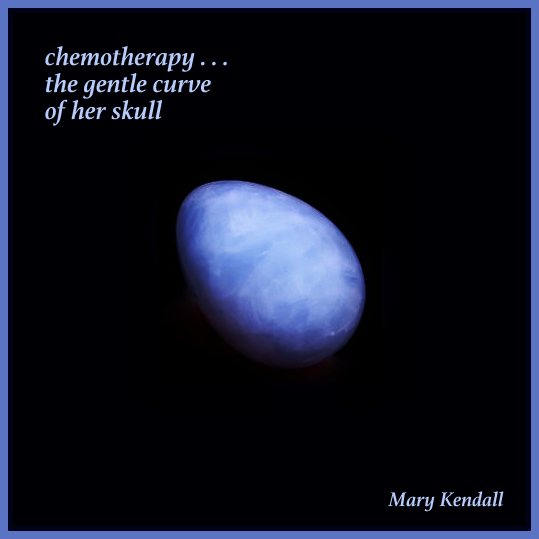
chemotherapy


~ This poem/haiga is dedicated to all who have struggled with cancer. ~

~ ~

A wonderful surprise email told me that a haiga of mine had been selected as an “Honorable Mention, Mixed Media** Category” in the Jane Reichhold Haiga Contest sponsored by two wonderful senryu journals:

Failed Haiku, A Journal of English Senryu Volume 1, Issue 11, edited by Michael Rehling

Prune Juice – A Journal of Senryu, Kyoka, Haibun and Haiga, Issue 20, November 2016, edited by Steve Hodge

The Judges of the contest were: Kris Kondo, Ron C. Moss, Michele Root-Bernstein

Michele wrote the commentary on my haiga: 


With the sparest of words and imagery, this haiga lays bare the essence of life in the face of death. If the poem skirts the uncertain boundary between haiku and senryu, just as certainly the picture skirts the shadowlands of mortality, its single image illuminating the darkness with a pulsating light. So well integrated are text and image that the associative leap between the two has the power of metaphor: the shaved skull is the incubating egg, never mind the incongruity. Avoiding the maudlin and the sentimental, this haiga speaks simply, honestly, of the beauty to be found in the ordinary, ordinarily hidden from view.”

This competition was in honor of the late Jane Reichhold who was such a brilliant poet, teacher, editor and mentor to so many who write haiku, senryu, tanka and other small form poems. I never had the honor of meeting her, but her main book on haiku has been a bible for me and so many others.

**Mixed Media, which can be any combination of traditional and photographic, or computer generated images and text.


Mask Maker

Who are we really? We can present ourself to the world in many ways, and we do. It’s been quite a while since I posted a longer poem on my blog, so today I offer you a poem called “Mask Maker.” It was written to an ekphrastic prompt on Rattle a few months back, but it was not selected. The two winning poems were brilliant and should have been chosen.

.
What’s great about writing to a good prompt is how an image can pull all sorts of ideas from us. The prompt was a picture of several sets of hands modeling in clay. I toyed with the idea for quite some time and discarded two other poems until I settled on the one that grew into this poem.


Mask Maker


Do you like this mask, the one I made

so carefully, molding it to the contours

of my face so it looks just like me?


I wear it day after day, occasionally

slipping it off and refashioning it a bit.

It changes as I change.


I was four when I made the first mask—

out of mud from the bare earth in the yard.

It blocked my fear, and hid my thoughts.


I was invisible to the world, hidden behind

this new cover. No one noticed when I wore it,

so I kept it on, and it protected me.


Once it nearly shattered during that long fall

down the stairs that he never spoke about.

Dazed, I woke up and checked the mask.


It was the one thing that hadn’t been hurt.

After that I knew I needed it to keep me safe,

to keep me quiet, to keep me out of the way.


When I closed my eyes, I could imagine it was

no longer a mask but just me, unseen by him.

It made me look like a normal girl, a good girl.


After many years and many masks, I became

quite good at molding a mask so flawlessly thin,

so delicate, transparent as a butterfly wing.


It was easy to slip on, and no one could tell

what was real and what was not, even up close.

It worked, and that’s all I ever wanted.


There is a small secret I learned from making

masks and wearing them day and night:

You must believe it’s you and not a mask.


It is you, but a different you, a you that won’t

cry out or tell secrets or even cringe too much

when unexpected blows come (and they do).


Close your eyes now. Imagine yourself this

way—in control and protected from the world,

safe from everything you fear, hidden far away


behind this lovely mask where you can watch

what’s going on, where you can be vigilant,

and where you are the real you only you can see.