As a follow up to my last blog, I’m reblogging this second lamentation that dates back to November 4, 2014.
Which classic myth would YOU choose to write a poem about? What grabs your mind and heart both?
The Second Lamentation of Demeter
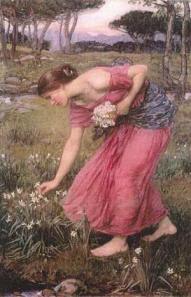
Narcissus, 1912 by John William Waterhouse
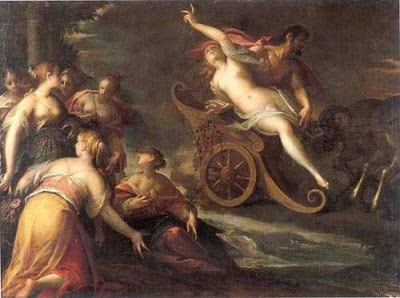
Persephone’s abduction by Hades is swift, violent and over so quickly that no one hears her scream except for Hecate, a goddess who helps Demeter find out where she has gone. Could there be anything worse for a mother than to lose a child? Demeter’s grief is profound. This is the Second Lamentation of Demeter.
The Abduction of Persephone, Hans Von Aachen, 1587
To hear me read this poem, please click on the link below and wait a few seconds for it to begin.
The Second Lamentation of Demeter
The earth groaned, then opened briefly.
That’s all it took.
He appeared out of nowhere
Like a wild flume of fire,
The flickering golden chariot with
Four black stallions at full gallop.
He sprang upon her so quickly
That when the earth closed back
Upon itself like a wound healed over,
All that was left was a circlet of flowers
That she and the daughters of Oceanus
Had been stringing together. Irises, roses,
Violets, hyacinths, and the faded blossoms
Of sweet narcissus plucked by her hand.
The scar in the earth and grasses torn apart
Were all that told the story.
I always knew he watched her…
I sensed when he was around.
Clouds gathered overhead,
Shadows clothing him in darkness,
Hades,
To whom sunlight is a stranger.
My sweet Persephone is gone now,
Gone with him.
O, horror…
My sweet child is his.
Persephone’s abduction is well represented in art. It is my personal opinion that one need look no further than the magnificent sculpture done by Bernini in 1622. The details of the hands and arms as well as the force and resistance between their two bodies is powerful. Persephone’s tear stained cheek tells us more than any words can.
Gian Lorenzo Bernini, The Abduction of Persephone, 1622, Galleria Borghese in Rome
Here it is January 2026. My blog has been quiet this year for a number of reasons too long to list. But the most obvious reason is that of a block or mental ‘resistance’ to writing. Last year in 2024, I turned to sharing a few older poems of mine that I love. It was a good reminder to me of why I loved writing.
Today, WordPress showed me my latest stats. I rarely look at these anymore, but one thing I notice each time I see an update is that some of the poems I wrote relating to classical myths seem to be accessed the most. I wonder if, in this sad and tumultuous world and country (mine being the USA), we turn to mythology to find answers to timeless questions that appear and reappear over a lifetime. Who are we and why are we here? What is it we are looking for? What really matters? I am now 79. Those questions and many more have come up time and time again, and the answers have been quite varied over eight decades. What do you, dear reader, think?Why do we cling to myths and tales from long ago and from cultures we know only though history books, literature or art? I’d love to know what you think.
To honor some of these poems, I’m going to post my two Lamentations of Demeter, one at a time. To save some work, I’ll post the whole original poet from my blog. I hope you find some meaning in each of them or perhaps a way to think of something beyond our wild world of today.
British Museum GR 1885.3-16.1 (Terracotta C 529), AN34724001
Here is the original 2014 posting:
.
I’ve been looking over my writing notebooks written a while back but unread by anyone other than myself or my husband. The myths of Demeter and her daughter, Persephone, fascinate many including me. For a number of reasons these myths seem to appeal especially to women. Many of the great living women poets have written brilliant poems about Persephone (e.g., Louise Glück and Eavan Boland). The story is timeless.
.
In today’s poem I’ve written a Lamentation of Demeter. Demeter, the goddess of the harvest and grains, is often referred to as the mother-goddess since she represents fertility on earth. Her importance is indisputable. When she mourns for her missing daughter, Persephone (who has been abducted by Hades and taken down into the underworld by force) the seasons stop. Things stop growing and the earth begins to die before Persephone’s father, Zeus, intervenes. You know the story, but it is worth re-reading if you haven’t read any mythology for a while.
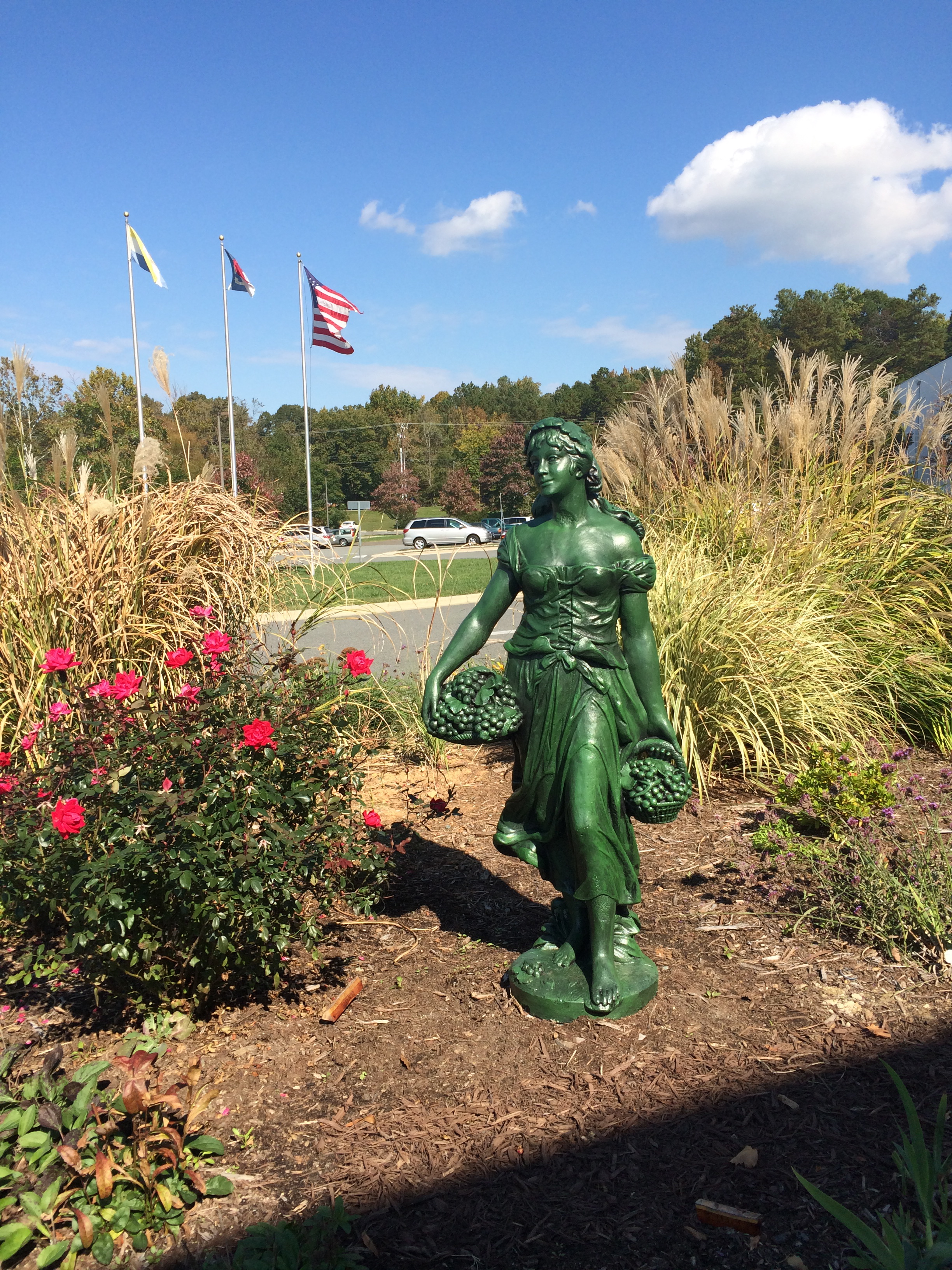
Demeter statue in front of my gym in Hillsborough, North Carolina
.
So what is a lamentation? The Oxford English Dictionary defines it simply: “The passionate expression of grief or sorrow; weeping.” Anyone who has grieved knows instinctively what it is to lament the loss of someone who is dearly loved. The feeling is painful and deep, and I think this resonates within us all. Demeter mourned her daughter’s abduction to a point where the earth nearly perished. This poem begins with her not yet knowing all that has happened. I picture her as a mother desperate to know what has happened to her child.
.
This is one of two lamentations of Demeter I’ve written. The second will follow at some point.
Demeter
.
To listen to an audio recording of me reading this poem, click on the link below and wait a few seconds for it to begin:
.
.
The First Lamentation of Demeter
.
How is it that I don’t know where she has gone?
I warned her.
I told her time and time again not to trust them,
that there were those who so longed for her
they would stop at nothing.
And who was right?
Like all girls her age, she could be headstrong,
believing her own mother too old
to understand those yearnings.
I warned her.
Last night I watched the dog star rise up.
Its magnificent beams were like beacons
that might lead me to my lost child.
Why is it the stars are silent?
O, Sirius, your brilliant rays reach down
to us and yet your silence is puzzling.
Surely you saw where she went, my only child.
{Sometimes old poems ask to be reworked. This is a small example of just that.}
On Growing Old Together, A Love Poem
Will you scatter me over water or throw me to the winds, letting me float away?
Will your ashes mingle with mine one day when you too are gone . . .
Ashes to ashes . . .
Will you take my hand again and hold me close against the wind? Will your eyes always smile with mine?
Dust to dust . . .
Will our hearts travel as one no matter where that might be? Will our love be forever?
Two stars together.
November 2025
This is a love poem written for my husband. We met in 1974, fifty-one years ago. This poem originally appeared on this blog in 2015, but I was never really happy with the ending. It never felt “right” to me. Those of you who are writers will know the feeling. You will know that some poems are meant to pop up again for you to rework it until it really is complete, and this is what I have done.
Growing older together has been a gift to both of us. We have shared so much and grown so much. Love is the one constant in the equation we call life. This poem is dedicated to my beloved husband and to all who have loved and been loved.
I’ve recorded myself reading the poem should you care to listen. Just click on the button below and give it a half a minute to begin.
This is an old poem that was originally posted in the early days of this blog, back in 2015. My writing lately has come to a standstill, but rereading things written a while ago is often a way to trigger a creative response. (Let’s hope it works.)
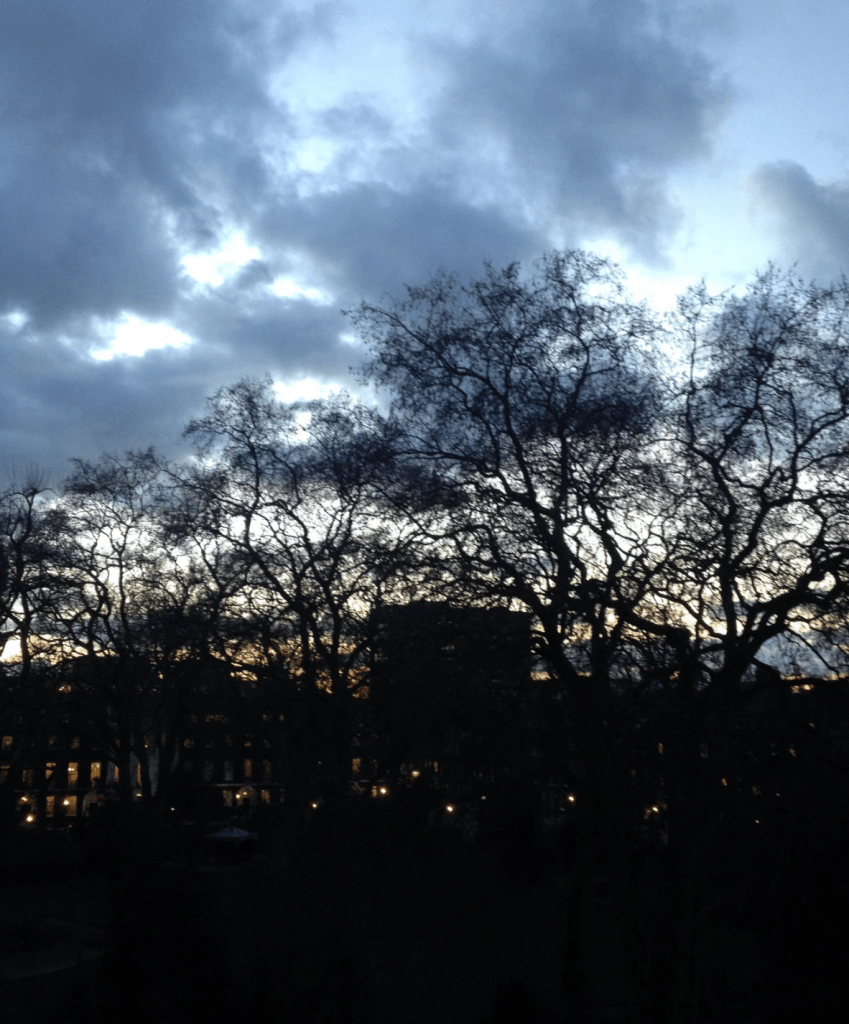
The poem was written when we were living in London for a spring term with university students who were studying abroad. Wonderful memories of that group who are now fully grown and probably leading interesting lives.
We live in Chapel Hill, North Carolina in a beautiful rural development that is filled with gardens and trees. Our single acre plot is divided into flowers, vegetables, invading weeds and cultivated trees. The back half of our acre is woodland and beyond that runs a small railroad track that is used for a daily single train that carries coal to the university nearby. Sounds are important. In winter we can hear a distant passenger train at night. In summer it’s blocked by all the greenery. Chapel Hill is truly verdant as is the nearby town of Hillsborough. Our trees are a mixture of hardwoods (oak, hickory, beech and evergreens (mostly loblolly pines but a few small cedars and hollies). Our beautiful Camellias bring winter color and our small (hand-dug) pond delights us with frogs serenading one another. Southern summers are never quiet. Katydids and Cicadas sing during the hottest part of the year, and all sorts of songbirds visit as we work in the garden or sit on the screened porch.
One of my favorite parts of living here is listening to the trees blow. Whether a storm is coming or not, the very tall trees have a life of their own as they blow and move. It is quite often a very sacred sound.
The trees today brought to mind this ten year old poem for me to reread (and now, to repost).
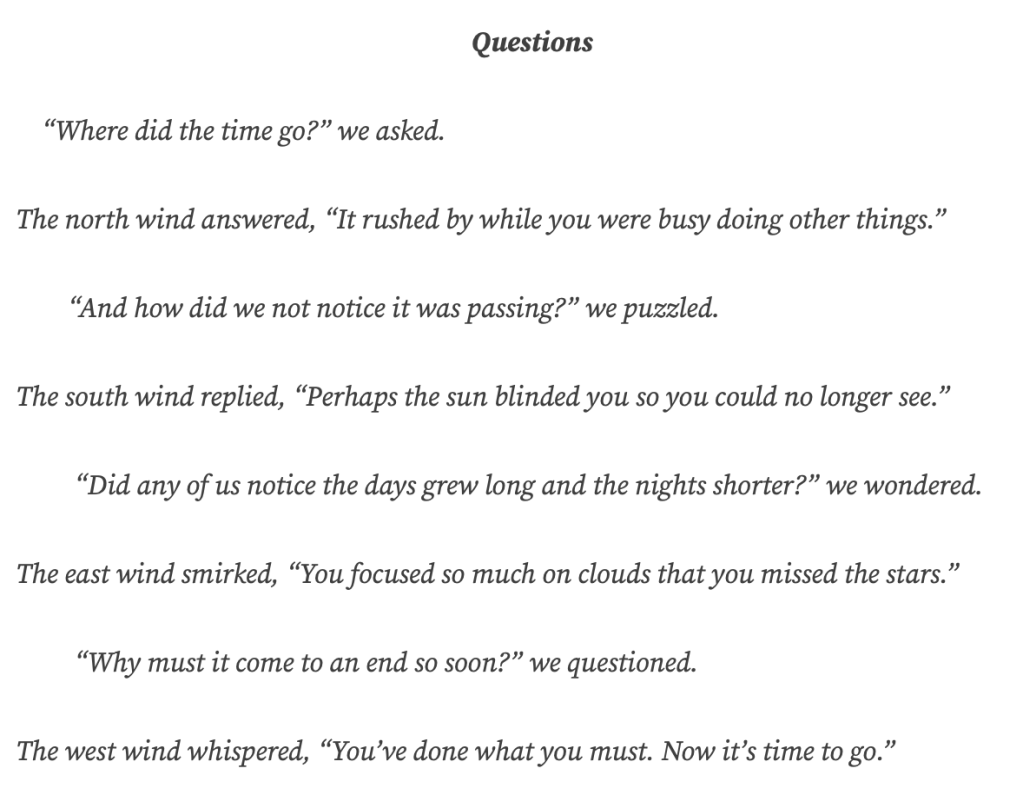
Questions was originally published on this blog on June 19, 2015. Ten years ago and still the same questions arise.







 A Poet in Time