
Wild Water: Three Tanka
1.
throughout the long day
the wild water crashes
again and again—
memories of you silently
slip under water
2.
as evening comes
the tide begins to swell
in the empty sound,
one lone boat
longing to set sail
3.
foghorn rasping
deep and low—
a bleak song
of ships surrendering
to savage waves
Tag Archives: grief

Small Poems of Grief

Grief, by Iosatel, The Obvious and Hidden blog, (c) 2014
1.
only the bereaved know
they needn’t speak in whispers,
grief is never
completely silenced
2.
rush of water
a broken branch drifts by
what will be left?
3.
Unending days of darkness
that never let you forget.
4.
Saturated, as if the clouds
had wrung themselves out
all at once, watching what
would then ensue
5.
sitting at the window
watching the rain
despondent days
of unexhausted sadness
trying to let go
6.
forgetting you
was never an option
7.
grief exhausts
but holds on,
rain continues
to fall
8.
thirty-five years and still I mourn you,
sometimes waking and imagining you there
9.
darkness deepens
into the black of night
lightning signals
thunder cracks,
but it is the loss of you
who took your life
that makes me ask
why it had to be
~~~
My Note of Thanks to the photographer, Iosatel, for his beautiful picture, Grief, which was first posted on his blog, The Obvious and the Hidden on 4/11/14. This photograph is copyrighted (c) 2014 by the artist himself.
The Broken Promise: Orpheus and Eurydice, poem by Mary Kendall (Mythic Poetry Series)
A second poem of mine in the Silver Birch Press Mythic Poetry Series! I’m delighted they selected this one.
I’ve done an audio clip of me reading this poem. Click below if you care to listen.


The Broken Promise: Orpheus and Eurydice
by Mary Kendall
If only he had kept his promise, she’d be there.
All it took was one glance, a quick turn,
a meeting of the eyes and then she vanished.
How long did he stand there staring at where she had been?
When did he realize that she was lost to him forever?
How sad the stars were that night,
tumbling through the black sky
in mournful arcs;
even the moon turned its face away.
As he lead her out toward the ledge,
did she gasp at her unsure footing?
She with her snake-born limp,
trying hard to keep pace through dark tunnels
winding up to the craggy precipice?
Was this what tempted him to look?
His glance came so naturally,
that of the husband who worried
his wife might stumble and fall.
His trust in her never wavered and yet
he looked…
View original post 158 more words
The End of Autumn

“In my End is my Beginning”
The End of Autumn
How could we pass through autumn
without thinking about life.
Life and death.
Life and birth.
Birth and death.
The book ends of our existence
with pauses of space in between
waiting for us to write the chapters
that will fill the empty volume
that eventually defines a life.

These photos were taken by me at the Duke Hospice at The Meadowlands in Hillsborough, North Carolina. This hospice is set on an old farmstead in rural Orange county. The hospice and grounds are a wonderful gift to all who pass through.

Quotation embroidered and worn by Mary, Queen of Scots
The Second Lamentation of Demeter ~ (Poetry and Myth)

Narcissus, 1912 by John William Waterhouse
Persephone’s abduction by Hades is swift, violent and over so quickly that no one hears her scream except for Hecate, a goddess who helps Demeter find out where she has gone. Could there be anything worse for a mother than to lose a child? Demeter’s grief is profound. This is the Second Lamentation of Demeter.
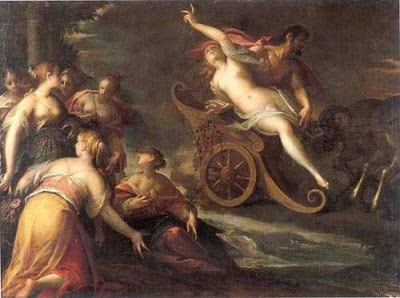
The Abduction of Persephone, Hans Von Aachen, 1587
To hear me read this poem, please click on the link below and wait a few seconds for it to begin.
The Second Lamentation of Demeter
The earth groaned, then opened briefly.
That’s all it took.
He appeared out of nowhere
Like a wild flume of fire,
The flickering golden chariot with
Four black stallions at full gallop.
He sprang upon her so quickly
That when the earth closed back
Upon itself like a wound healed over,
All that was left was a circlet of flowers
That she and the daughters of Oceanus
Had been stringing together. Irises, roses,
Violets, hyacinths, and the faded blossoms
Of sweet narcissus plucked by her hand.
The scar in the earth and grasses torn apart
Were all that told the story.
I always knew he watched her…
I sensed when he was around.
Clouds gathered overhead,
Shadows clothing him in darkness,
Hades,
To whom sunlight is a stranger.
My sweet Persephone is gone now,
Gone with him.
O, horror…
My sweet child is his.

Persephone’s abduction is well represented in art. It is my personal opinion that one need look no further than the magnificent sculpture done by Bernini in 1622. The details of the hands and arms as well as the force and resistance between their two bodies is powerful. Persephone’s tear stained cheek tells us more than any words can.

Gian Lorenzo Bernini, The Abduction of Persephone, 1622, Galleria Borghese in Rome

(detail)

(detail)
The First Lamentation of Demeter ~ (Poetry and Myth)

British Museum GR 1885.3-16.1 (Terracotta C 529), AN34724001
I’ve been looking over my writing notebooks written a while back but unread by anyone other than myself or my husband. The myths of Demeter and her daughter, Persephone, fascinate many including me. For a number of reasons these myths seem to appeal especially to women. Many of the great living women poets have written brilliant poems about Persephone (e.g., Louise Glück and Eavan Boland). The story is timeless.
In today’s poem I’ve written a Lamentation of Demeter. Demeter, the goddess of the harvest and grains, is often referred to as the mother-goddess since she represents fertility on earth. Her importance is indisputable. When she mourns for her missing daughter, Persephone (who has been abducted by Hades and taken down into the underworld by force) the seasons stop. Things stop growing and the earth begins to die before Persephone’s father, Zeus, intervenes. You know the story, but it is worth re-reading if you haven’t read any mythology for a while.

Demeter statue in front of my gym in Hillsborough, North Carolina
So what is a lamentation? The Oxford English Dictionary defines it simply: “The passionate expression of grief or sorrow; weeping.” Anyone who has grieved knows instinctively what it is to lament the loss of someone who is dearly loved. The feeling is painful and deep, and I think this resonates within us all. Demeter mourned her daughter’s abduction to a point where the earth nearly perished. This poem begins with her not yet knowing all that has happened. I picture her as a mother desperate to know what has happened to her child.
This is one of two lamentations of Demeter I’ve written. The second will follow at some point.

Demeter
To listen to an audio recording of me reading this poem, click on the link below and wait a few seconds for it to begin:
The First Lamentation of Demeter
How is it that I don’t know where she has gone?
I warned her.
I told her time and time again not to trust them,
that there were those who so longed for her
they would stop at nothing.
And who was right?
Like all girls her age, she could be headstrong,
believing her own mother too old
to understand those yearnings.
I warned her.
Last night I watched the dog star rise up.
Its magnificent beams were like beacons
that might lead me to my lost child.
Why is it the stars are silent?
O, Sirius, your brilliant rays reach down
to us and yet your silence is puzzling.
Surely you saw where she went, my only child.
Will no one tell me where my Persephone has gone?

 A Poet in Time