Depression is not very pretty. Nor is it very kind. It has many faces, and it comes and goes as it pleases. It can affect almost anyone. If you are someone who has struggled with depression, you know it never goes away completely but hides, waiting for the right moment to reappear. It isn’t something to be lightly dismissed in yourself or in others who suffer from it. Who hasn’t seen the devastating effect it can have on a vulnerable person? I’ve struggled with it, and I’ve certainly known many others who were also affected by it.
.
Watching someone you love battle depression is never easy. It isn’t easily “fixed,” even in this age of modern medicine. Therapy and medicines are there, and for some people they help so much, but for others, less so. Compassion, patience, unconditional love and presence are the lifelines we can offer…to someone else and to ourselves.
.
To listen to me read this poem, please click on the link below. It will take a minute to begin.
.
.
Compassion
Taking on your pain was something I tried to do, like slipping on your jacket, pushing an arm in and then another, pulling it tight around myself, hoping that by feeling what you do, it would diminish your pain.
No matter how hard I tried, it wasn’t a fit. Your depression fell around me in loose folds, the sadness sagging around my heart. Besides, it would leave you cold, open to the fickle winds that blew your way.
If you’d like to hear me read this poem, please click on the link below. Wait a few seconds for it to load. I hope you enjoy both listening and reading this love poem.
Another Love Poem…
~ To my husband and partner of forty years ~
We walked along in the Tuileries alone among the chestnut trees,
morning sky of crisp pale gold so many paths we have strolled,
and still we wander, just us two, my heart never very far from you.
We stop to sit and watch the birds green park chairs, unspoken words,
plain sparrows chirp, so unadorned no beauty lost, no beauty mourned.
Simple thoughts are often most true— no man was ever loved more than you.
New Note as of March 11, 2016: This poem has just been published on a favorite online journal called Ekphrastic: Writing and Art on Art and Writing. A link to the journal: http://www.ekphrastic.net/ekphrastic/beauty-in-broken-pieces-by-mary-kendall
~ ~ ~
Readers of this blog don’t always notice its subtitle: One Poet’s Practice. I like to practice. I like to experiment. All poets do. Without stretching the mind, you fall into the pattern of repetition. Each poem starts sounding like the last or the next.
I have been writing a lot in short form poetry–haiku, haiga, tanka, and other small poems. Today, in an effort to go in a completely different direction, I offer you a very long, rambling poem–quite unlike me, I know. It is called “Beauty in Broken Pieces,” inspired by a lovely photograph taken in Dublin, Ireland by India Leigh Lassiter, herself a talented writer as well as photographer. Thank you, India, for allowing me to use your picture as a starting point for this poem.
To hear me read this poem, please click on the link below (give it a minute to load):
Blue Spiral, Dublin, Ireland (c) 2015 photograph by India Leigh Lassiter
Beauty in Broken Pieces…
Perhaps it was once a deep blue vase,
holding seven pale pink peonies
freshly cut one May morning…
the silence shattered
suddenly when
she lost her balance,
grabbed
the oval table
and together
crashed down,
one in splintered pieces,
the other dazed
watching the water
slowly spread
under the petals.
Or perhaps…
it was packed away in a doctor’s study,
an old cabinet filled with bottles…
cobalt blue bottles with faded labels,
the dark blue hinting of hidden secrets,
dangers that lay in long-dried residue
of those bottles that were shattered
and thrown upon a fire
that raged for hours,
flaring up in vivid hues
of acid green
and mustard yellow,
tipped with amber,
azure and moon,
the air once heavy
with poison
and dreams.
Or…maybe
there was no story.
Do you believe the whole really is bigger
than the sum of its parts?
And please, don’t let’s forget
there is always
perspective.
Large things are large,
but small things
are also large
if seen
close
up.
It is lovely, this small mosaic
made of glass in shades of blue,
blue so dark,
it might still hold the sound
of the ocean from the sand
that washed up and back
over and over
dancing on the ocean floor
before it became
the glass
we see…
for what is glass
but sand
and fire,
beach
and
star?
even
a simple
spiral
mosaic
in shades
of blue, pearl and silver
might hold the deep bass song
of the darkling ocean,
the glimmering
whispers
of clouds
above,
patterns spiraling through nature
like our thoughts about beauty,
reality or memory’s truth
Fibonacci gave it his name,
the Greeks gave it meaning
with their golden ratio…
it exists everywhere
… a simple nautilus shell,
the sunflower’s seed head
that turns to the sun,
and following its cue, the pinecone,
the hurricane, even the galaxy, the cosmos
and here with this Irish glass spiral
we come full circle of woman
with camera, snapping
a photo, capturing
the balance of
silvery bits
and pearl
to blue
done
just
so
.
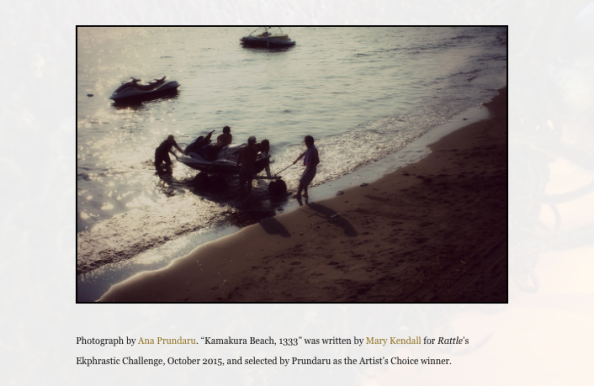
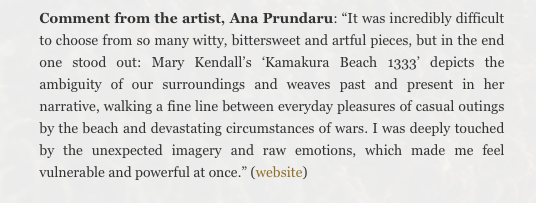
I am both speechless and honored by the selection of my poem, “Kamakura Beach, 1333” as the artist’s choice of the October ekphrastic challenge by Rattle, one of the finest contemporary poetry journals. The artist/photographer is Ana Prundaru. My thanks go to Ana for selecting my poem for this challenge. I am deeply touched by her very thoughtful and generous comments.
To read the poem or listen to the audio on Rattle, here is the link:
Note: there is an audio of me reading the poem on the Rattle page but I’ll include it here as well:
~
Kamakura Beach, 1333
The sea washed scarlet that night.
The tide rushed in—swelling and breaking—washing all traces out to sea on the waves of Kamakura Beach.
You know nothing of this, you who long for adventure and pleasure—youth who search desperately for meaning in lives that are too rich, too busy, and still so poor.
Your small boats arrive in early evening, the carmine sunset at your back, and you quickly gather driftwood, tinder, and fallen black pine branches to burn. You light the fire.
A trail of smoke begins funneling up to the starry sky. The fire burns hot and one by one, you feed it twigs, boughs, pine cones bursting into streams of sparks and wild flames.
And in your wanton rambling, one girl grows silent—she alone hears the hallowed chanting, the cries of battle, the shrieks of arrows piercing skulls, the stench of life exiting too abruptly.
She wanders over shallow rocks, her hand touching stone, knowing the pain hidden in the silence of eight hundred years. The rest of you are unaware…you laugh too loudly, move
too fast, not noticing the shifting colors of the setting sun. Listen and you will hear the shogun cries of warriors and farmers that once shook the sacred sands of Kamakura Beach.
Can you smell the fierce fires, the burning buildings, the blazing rafters crashing and lighting the darkening sky? Can you hear the screams of those buried here long ago?
Time slipped by like swifts at dusk darting in the fading sky. The fire raged on and on, and lives were ravished in a single breath. It was our fate to die on Kamakura Beach.
With Samurai mind and clean, sharp blows, the sacred sword was swift. One by one, we died…each of us choosing honor, this bleak beach now strewn with bones, bodies and blood.
You who come to visit—feel the cool churning lapis blue water, and see the late sun boldly brush red on sand, water and waves. Remember us—we who lie buried on Kamakura Beach.
Let your fires roar, let them spark in comets to the stars. Under the dark night skies long written in indigo and ink, we will walk together here on Kamakura Beach.
Morning tide will come—swelling and breaking—washing your presence out to sea— remembering our final night, a night of fire and blood, bone and bodies on Kamakura Beach.
Rattle also posted a download of a broadside that includes poem and picture side by side. It is so beautifully done with the shadows of the boat creating a subtle image under the poem. Very appropriate to this particular poem, I think.
As many of you know, I love art. I love going to art museums, galleries and art shows. Art history has always been one of my passions, so it’s natural enough that ekphrastic art and writing has captured my interest. A very simple definition of ekphrastic poetry is writing a poem in response to a work of art. It can be descriptive or it can be a response of any sort to the piece. There are no restrictions, no limits, and that by itself is something that has great appeal. The same goes in reverse–an artist might create a piece in response to a written work. My own blog has poems written about ancient Greek mythology, and in each posting I’ve included beautiful works of art that are ekphrastic responses to the myths.
This particular poem was a response to a show of the artwork of Ronna S. Harris that was held at the Turchin Art Center at Appalachian State University in Boone, North Carolina. My husband and I fell in love with her work and this particular painting has haunted me for nine years. This poem is my response to it. My thanks to the artist for her permission to use this painting here and in the journal it was recently published in. I hope some of you will wander over to her own website to look at the gallery of paintings she has there. I still dream of owning one of her works of art. Her website: http://www.ronnaharris.com
Note: My thanks to editor Lorette C. Luzajic for publishing this poem on September 13, 2015 in Ekphrastic: writing and art on art and writing:
Painting: Almost Surrendered, by Rhonna S. Harris, 1992.
Picture used with permission of the artist.
Click the link below if you’d like to hear me read this poem. It takes a few seconds to load.
Almost Surrendered: On Being and Nothingness
The gallery was empty, the artist unknown to us.
Strangers to her work, we walked in quietly,
speaking in whispers about the way she painted
a rich purple aubergine or the clear, shimmering water
in blown-glass bottles. Illusion so real it was perfect.
Her paintings seemed direct but insinuated that
something might be hidden just beyond our view.
From fruits and windows, vegetables and doorways,
suddenly there was a room full of large paintings of figures,
mostly nudes with evocative names like “Pieta” or
“Architecture of the Perfect Man.”
We stopped in front of one called “The Marriage.” It showed two figures lost in thought, in separate worlds.
It reminded me of what marriage is like for some after
so many years together. Still, silence doesn’t always speak
of distance but of an understanding of hearts.
And there, on the left wall, was “Almost Surrendered.”
A pale naked woman with arms by her side, palms stretched up
in prayer or supplication. She was translucent, existing half here,
half there. Behind her was a closed window. She wore a gold chain.
Was she a memory, a body giving way to death or being reborn?
Or was this ghostly surrender all illusion, a message
to women who have given too much of themselves?
A woman who had lost herself in trying to be everything.
Could she be a dream?
You moved on to the next picture and then the next,
but I stood there staring at this vanishing woman and
wondered who it was who really had surrendered.
Was she any woman?
Could she be me?
You reappeared, and together we moved on.
This time round, I found myself thinking about windows
in pictures, of what lay beyond the glass the artist
drew, surrendering myself to what she didn’t show,
what she concealed in her mind like a stage curtain pulled back
just enough to hint that maybe others stood on the other
side, looking back at us from a completely different angle.
Would they study us closely, marveling at our verisimilitude?
the lovely glazes of color so skillfully applied, built up so
carefully to a level of opacity that suggested real inner depth?
Would they compare us to the other figures in the gallery
and wonder why we were not painted as a man and a woman
fading from view, surrendering to a love spoken in silence?
Today’s poem is a slight detour down the road that leads to summer’s end. I’ve chosen to present an acrostic poem, a form I always enjoyed using when writing with children during my years of teaching. Acrostic poems are delightful and often funny, but as shown here, they can be serious and even tender.
You can hear me read the poem if you click on the link below and patiently wait a few seconds for the recording to begin.
.
Summer’s End
.
Sunflowers bloom tirelessly all summer long
Unwavering in their deep devotion to the sun
Multiplying day by day, the fields grow yellow
Making everyone stop to look
Elegant with their tall, swaying stalks
Regretting nothing, they give themselves to this season
Surrendering ripe seeds to the redbirds and finches that gather round
.
Photo by Betty Rizotti, (c) 2015
.
Even summer must come to a close
No one is ever spared the final moment
Depleted of seed, sunflowers begin to bow their heads in sleep
Photo by Jan Monson, (c) 2015
Photo by Gary Birchford, (c) 2015
Photo by Gary Brichford, (c) 2015
Photo by Gary Brichford, (c) 2015
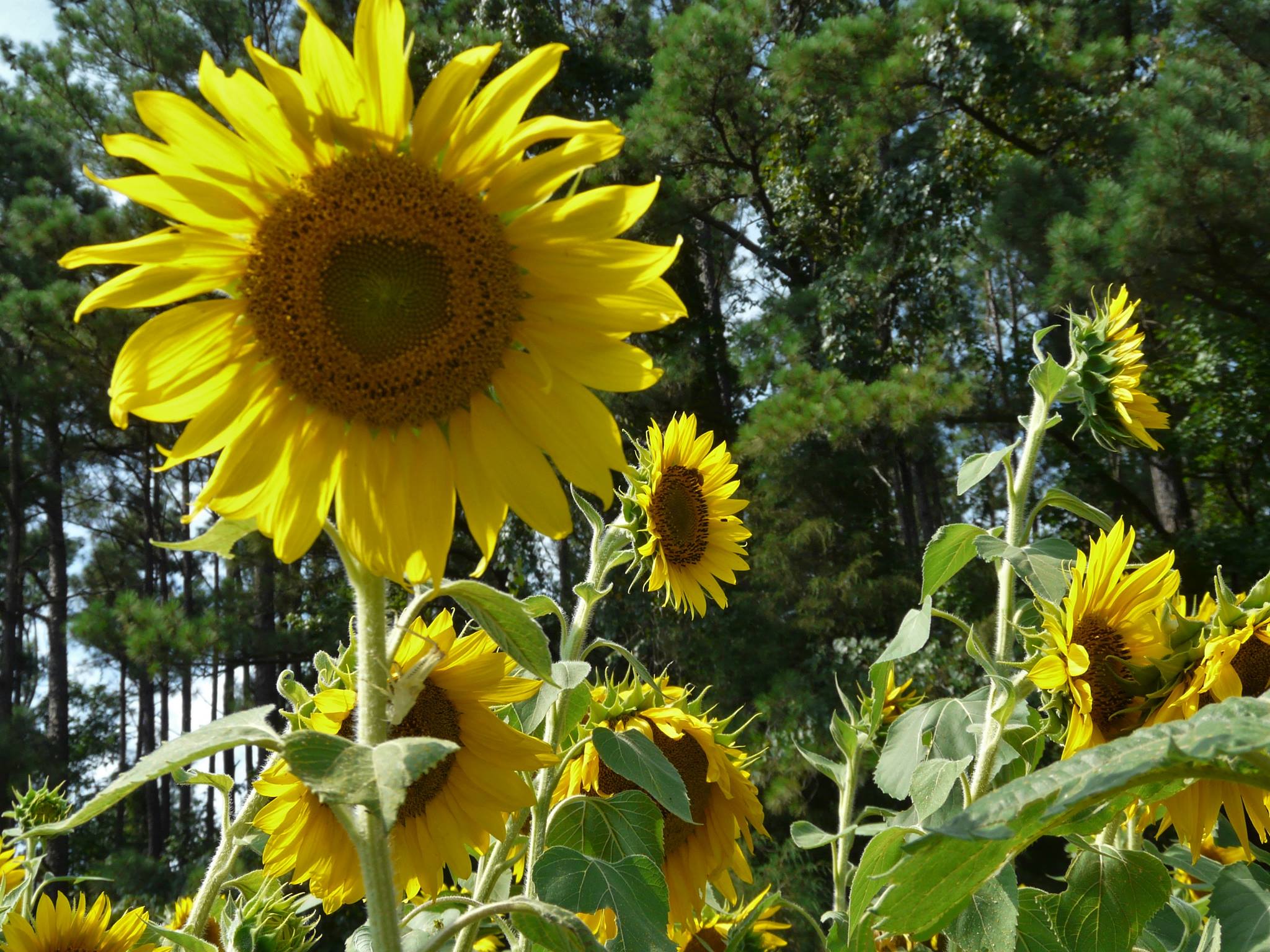
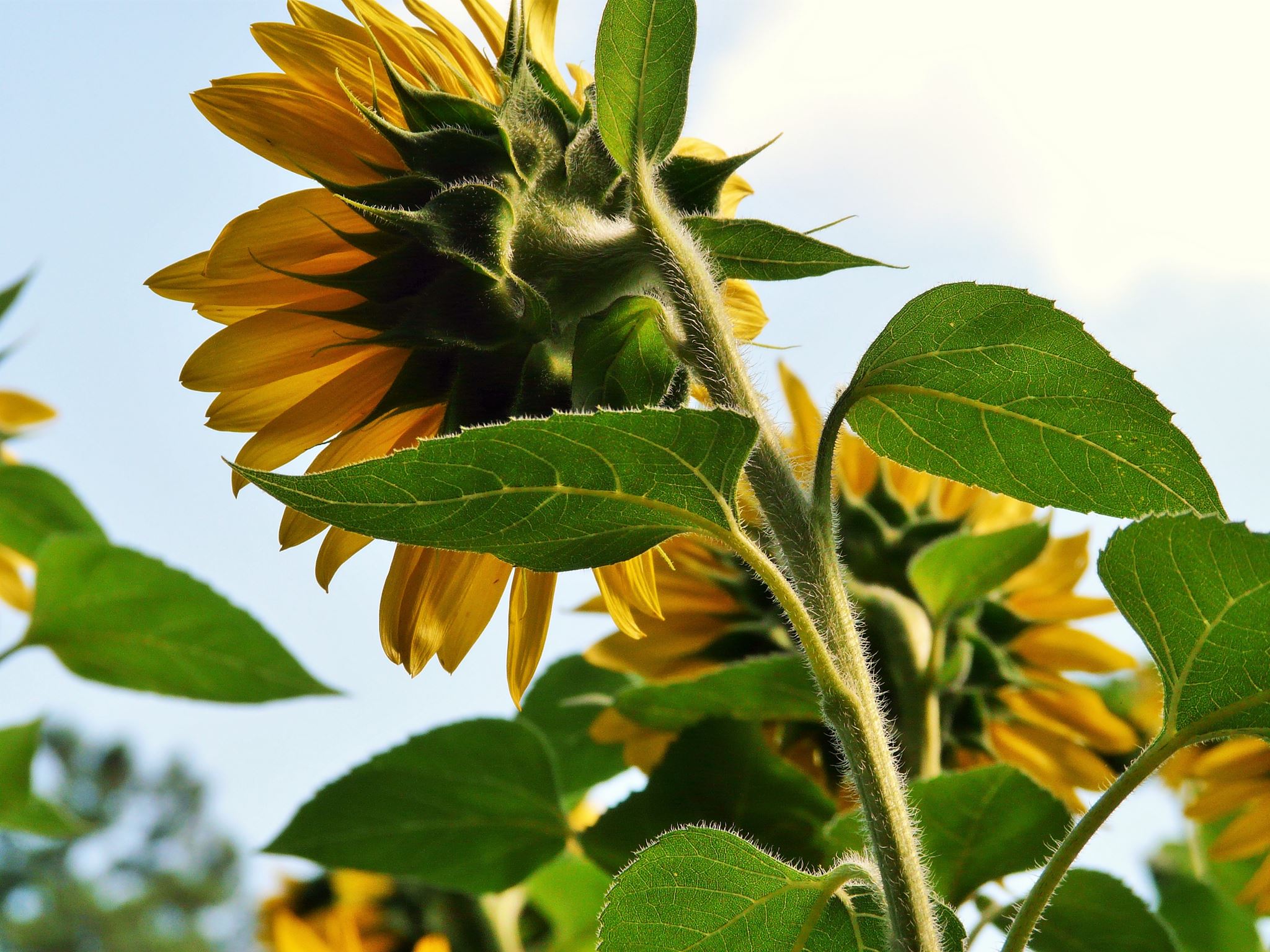
Several photographers are responsible for the beautiful sunflower photographs in this blog. The two with the goldfinches are shared by Betty Rizzoti (middle right photo) and Jan Monson (middle left photo). Many thanks to each of them for these great captures. All the rest of the photographs are by Gary Birchford whose photographs, when posted on FaceBook last month, inspired this poem as a goodbye to summer. Thank you Gary for your ever generous heart in allowing me to use these pictures.
.
Photo by Gary Brichford, (c) 2015
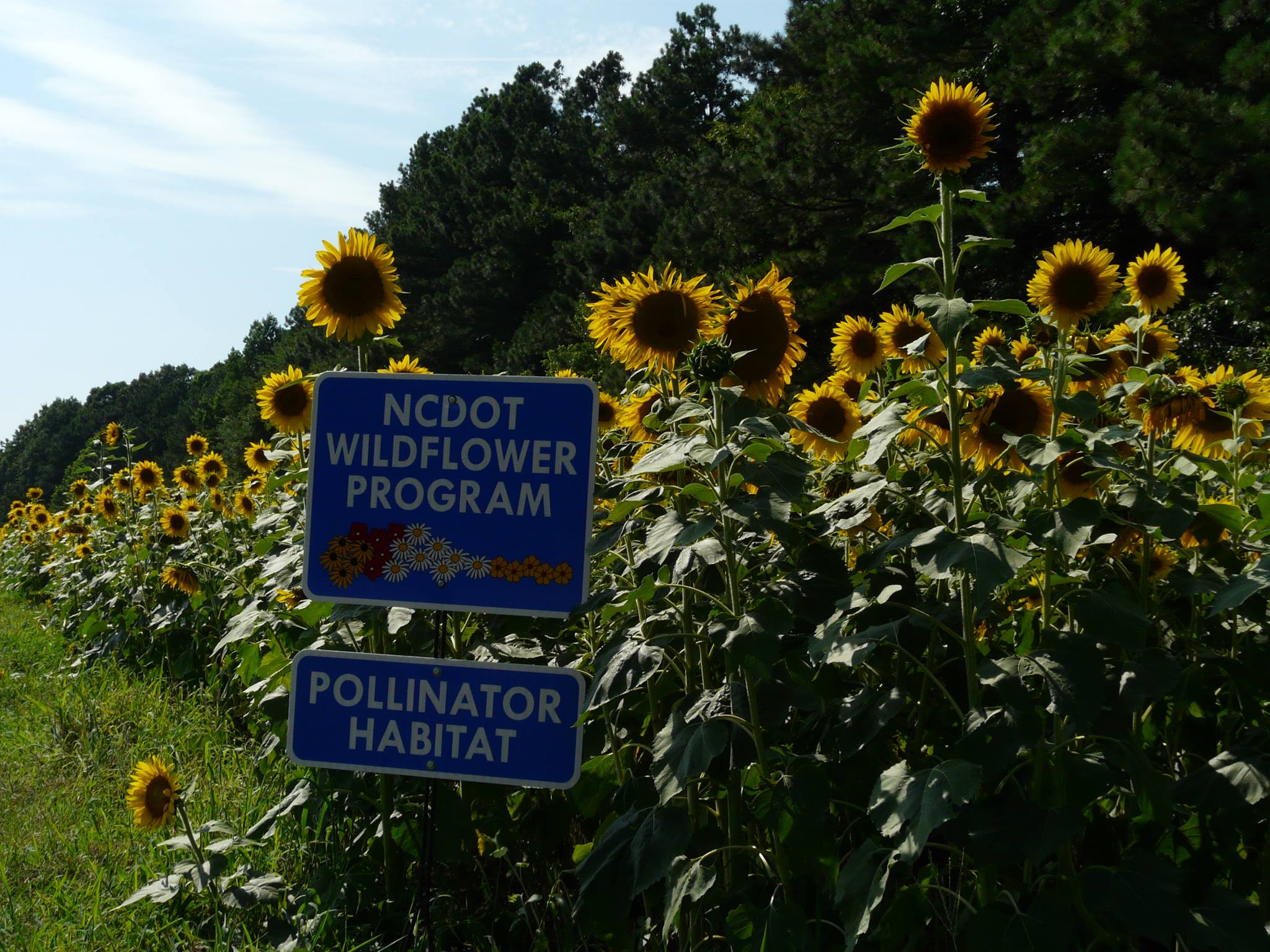
One final note: Gary Brichford took this set of sunflower pictures from an interesting source. They were on the side of a major highway in central North Carolina as part of a government project. Please see the picture below for details. Isn’t it great to know that our Department of Transportation is involved in Pollinator Habitats. What better place could they find. Imagine how many people drive past and smile at the ever beautiful sunflowers.







 A Poet in Time