Full Moon of the Winter Solstice (c) 2010 Martin Liebermann
As I post this, it is the morning of the winter solstice of 2015. Where I live in Chapel Hill, North Carolina, the winter solstice officially happens tonight at 11:49 pm, EST. Wherever YOU are, it will happen at a different hour or perhaps the same. Readers of this blog come from all over the world–one of the joys in blogging is seeing the list of countries of readers–and I love imagining the moon going through its magical phases for each of you. Tonight, the solstice. Later this week, a full moon. What more could we want?
These are some of my earliest haiku:
WINTER MOON HAIKU
First published on Poets Online (c) Mary Kendall
Later used as lyrics in “Winter Moon” by Paul Carey, a piece for women’s chorus in (c) 2011.
night snow
boughs dreaming
of first blossoms
Fog filled woods~
even the winter moon
has lost its way
a winter walk
footprints
tell no tales
the blue moon
silently closes the door
upon the year
It was a very exciting moment last week for me to open up the latest issue of Moonbathing, a journal of women’s tanka, and see one of my own tanka included. To be in the company of so many very talented tanka poets is a highlight of my year.
Published by poet and editor, Pamela A. Babusci, Moonbathingis a journal that showcases the many sides of tanka. The poems cover a wide variety of experiences, emotions and subjects…and all written by talented women poets.
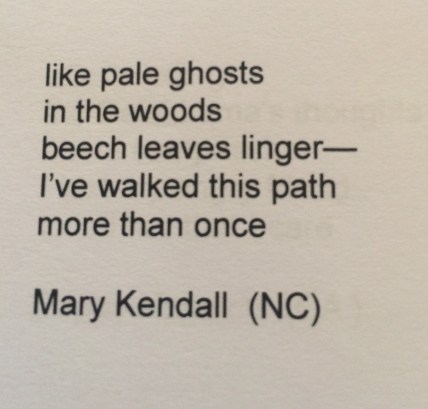
Here is my tanka:
Moonbathing is edited and published by Pamela A. Babusci
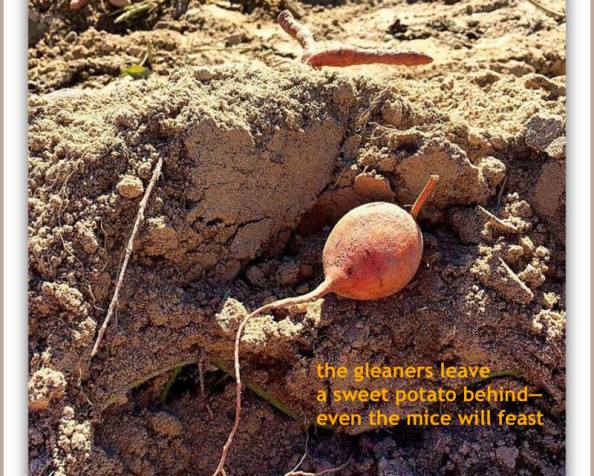
This beautiful photo was taken by a friend, Patti Hardee Donnelly. Patti is a Middle School Language Arts Teacher at the same school I retired from. Each grade level does regular community service, and the activities are varied. Last month, Patti took her Middle School Advisory to spend an afternoon of gleaning sweet potato fields. As they were working through the fields, Patti took this photograph. She very kindly let me ‘borrow’ it for this haiga.
The concept of gleaning is an ancient one. So long as people have planted fields of crops, others have followed in their wake to glean whatever food might be left behind. It doesn’t matter if the vegetables are picture perfect, so much as they provide food for those who are without. Taking a group of middle class students who are in no danger of starving is a very purposeful way of both doing community service and providing a life lesson to the students. The gleaned sweet potatoes do end up on dinner tables of people who are happy to have healthy, fresh produce. The students who do the gleaning, perhaps for the first and last time of their lives, surely learn a lot about the facts of poverty and hunger. They learn a lesson in simple compassion. How often do most of us come face to face with the pain of hunger? The answer for the majority of Americans is ‘rarely.’
Here in the United States, we have just celebrated Thanksgiving, a time in which we feast and share our meal with those we love. Soon our thoughts will move on to Christmas, Hannukah, Kwanza, winter solstice, New Year’s and a whole period of seasonal gift giving, sharing food and good spirit. Let’s stop for just a minute and think about all we are fortunate to have–we who go to bed in a comfortable place after having had adequate meals. For December, I’m going to spend some time thinking about the concept of gleaning, both the physical and metaphorical. Having borrowed Patti’s beautiful photo and ‘gleaned’ it for my haiga, I hope I can find other ways to give back to the world.
Thank you, Patti Hardee Donnelly, for allowing me to use this picture, but thank you also for teaching your students about the importance of compassion and service to others. I will always celebrate and salute teachers like you who make a real difference in so many lives.
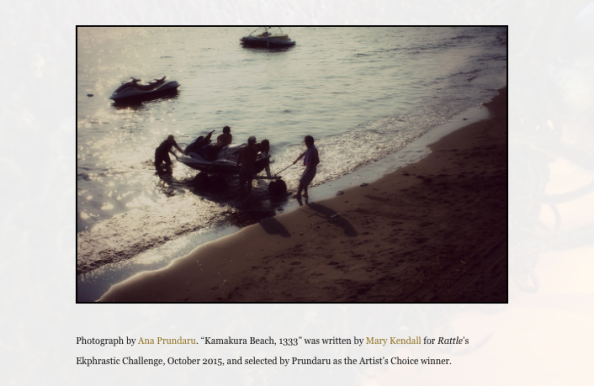
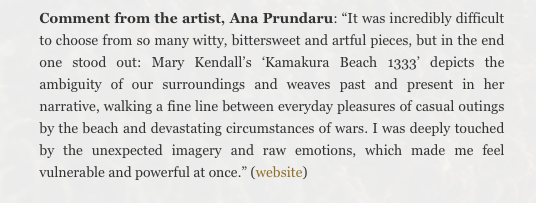
I am both speechless and honored by the selection of my poem, “Kamakura Beach, 1333” as the artist’s choice of the October ekphrastic challenge by Rattle, one of the finest contemporary poetry journals. The artist/photographer is Ana Prundaru. My thanks go to Ana for selecting my poem for this challenge. I am deeply touched by her very thoughtful and generous comments.
To read the poem or listen to the audio on Rattle, here is the link:
Note: there is an audio of me reading the poem on the Rattle page but I’ll include it here as well:
~
Kamakura Beach, 1333
The sea washed scarlet that night.
The tide rushed in—swelling and breaking—washing all traces out to sea on the waves of Kamakura Beach.
You know nothing of this, you who long for adventure and pleasure—youth who search desperately for meaning in lives that are too rich, too busy, and still so poor.
Your small boats arrive in early evening, the carmine sunset at your back, and you quickly gather driftwood, tinder, and fallen black pine branches to burn. You light the fire.
A trail of smoke begins funneling up to the starry sky. The fire burns hot and one by one, you feed it twigs, boughs, pine cones bursting into streams of sparks and wild flames.
And in your wanton rambling, one girl grows silent—she alone hears the hallowed chanting, the cries of battle, the shrieks of arrows piercing skulls, the stench of life exiting too abruptly.
She wanders over shallow rocks, her hand touching stone, knowing the pain hidden in the silence of eight hundred years. The rest of you are unaware…you laugh too loudly, move
too fast, not noticing the shifting colors of the setting sun. Listen and you will hear the shogun cries of warriors and farmers that once shook the sacred sands of Kamakura Beach.
Can you smell the fierce fires, the burning buildings, the blazing rafters crashing and lighting the darkening sky? Can you hear the screams of those buried here long ago?
Time slipped by like swifts at dusk darting in the fading sky. The fire raged on and on, and lives were ravished in a single breath. It was our fate to die on Kamakura Beach.
With Samurai mind and clean, sharp blows, the sacred sword was swift. One by one, we died…each of us choosing honor, this bleak beach now strewn with bones, bodies and blood.
You who come to visit—feel the cool churning lapis blue water, and see the late sun boldly brush red on sand, water and waves. Remember us—we who lie buried on Kamakura Beach.
Let your fires roar, let them spark in comets to the stars. Under the dark night skies long written in indigo and ink, we will walk together here on Kamakura Beach.
Morning tide will come—swelling and breaking—washing your presence out to sea— remembering our final night, a night of fire and blood, bone and bodies on Kamakura Beach.
Rattle also posted a download of a broadside that includes poem and picture side by side. It is so beautifully done with the shadows of the boat creating a subtle image under the poem. Very appropriate to this particular poem, I think.
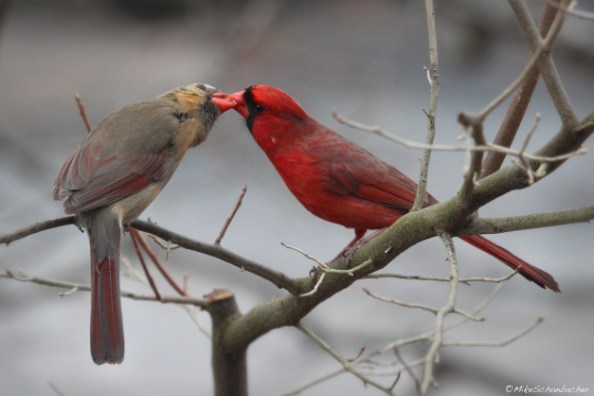
Note on Photograph: I can find no other attribution for this photograph other than it was taken in Woods Hole, Massachusetts in 2014. It has appeared in a number of online birding sites. My thanks to the anonymous (but talented) photographer for capturing this tender moment.
Today, on Ekphrastic: writing and art on art and writing, as part of their 20 poem challenge, I have three haiku to go with a gorgeous picture of swallows.
To read the poems and see the art in the original publication, please click on this link:






 A Poet in Time