I am both speechless and honored by the selection of my poem, “Kamakura Beach, 1333” as the artist’s choice of the October ekphrastic challenge by Rattle, one of the finest contemporary poetry journals. The artist/photographer is Ana Prundaru. My thanks go to Ana for selecting my poem for this challenge. I am deeply touched by her very thoughtful and generous comments.
To read the poem or listen to the audio on Rattle, here is the link:
Note: there is an audio of me reading the poem on the Rattle page but I’ll include it here as well:
~
Kamakura Beach, 1333
The sea washed scarlet that night.
The tide rushed in—swelling and breaking—washing all traces out to sea on the waves of Kamakura Beach.
You know nothing of this, you who long for adventure and pleasure—youth who search desperately for meaning in lives that are too rich, too busy, and still so poor.
Your small boats arrive in early evening, the carmine sunset at your back, and you quickly gather driftwood, tinder, and fallen black pine branches to burn. You light the fire.
A trail of smoke begins funneling up to the starry sky. The fire burns hot and one by one, you feed it twigs, boughs, pine cones bursting into streams of sparks and wild flames.
And in your wanton rambling, one girl grows silent—she alone hears the hallowed chanting, the cries of battle, the shrieks of arrows piercing skulls, the stench of life exiting too abruptly.
She wanders over shallow rocks, her hand touching stone, knowing the pain hidden in the silence of eight hundred years. The rest of you are unaware…you laugh too loudly, move
too fast, not noticing the shifting colors of the setting sun. Listen and you will hear the shogun cries of warriors and farmers that once shook the sacred sands of Kamakura Beach.
Can you smell the fierce fires, the burning buildings, the blazing rafters crashing and lighting the darkening sky? Can you hear the screams of those buried here long ago?
Time slipped by like swifts at dusk darting in the fading sky. The fire raged on and on, and lives were ravished in a single breath. It was our fate to die on Kamakura Beach.
With Samurai mind and clean, sharp blows, the sacred sword was swift. One by one, we died…each of us choosing honor, this bleak beach now strewn with bones, bodies and blood.
You who come to visit—feel the cool churning lapis blue water, and see the late sun boldly brush red on sand, water and waves. Remember us—we who lie buried on Kamakura Beach.
Let your fires roar, let them spark in comets to the stars. Under the dark night skies long written in indigo and ink, we will walk together here on Kamakura Beach.
Morning tide will come—swelling and breaking—washing your presence out to sea— remembering our final night, a night of fire and blood, bone and bodies on Kamakura Beach.
Rattle also posted a download of a broadside that includes poem and picture side by side. It is so beautifully done with the shadows of the boat creating a subtle image under the poem. Very appropriate to this particular poem, I think.
How could we pass through autumn
without thinking about life.
Life and death.
Life and birth.
Birth and death.
The book ends of our existence
with pauses of space in between
waiting for us to write the chapters
that will fill the empty volume
that eventually defines a life.
These photos were taken by me at the Duke Hospice at The Meadowlands in Hillsborough, North Carolina. This hospice is set on an old farmstead in rural Orange county. The hospice and grounds are a wonderful gift to all who pass through.
Quotation embroidered and worn by Mary, Queen of Scots
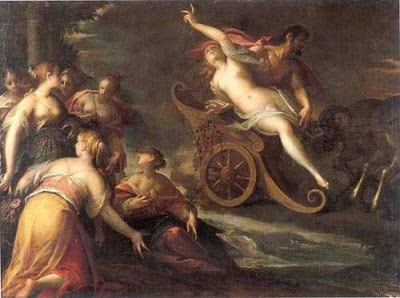
Persephone’s abduction by Hades is swift, violent and over so quickly that no one hears her scream except for Hecate, a goddess who helps Demeter find out where she has gone. Could there be anything worse for a mother than to lose a child? Demeter’s grief is profound. This is the Second Lamentation of Demeter.
The Abduction of Persephone, Hans Von Aachen, 1587
To hear me read this poem, please click on the link below and wait a few seconds for it to begin.
The Second Lamentation of Demeter
The earth groaned, then opened briefly.
That’s all it took.
He appeared out of nowhere
Like a wild flume of fire,
The flickering golden chariot with
Four black stallions at full gallop.
He sprang upon her so quickly
That when the earth closed back
Upon itself like a wound healed over,
All that was left was a circlet of flowers
That she and the daughters of Oceanus
Had been stringing together. Irises, roses,
Violets, hyacinths, and the faded blossoms
Of sweet narcissus plucked by her hand.
The scar in the earth and grasses torn apart
Were all that told the story.
I always knew he watched her…
I sensed when he was around.
Clouds gathered overhead,
Shadows clothing him in darkness,
Hades,
To whom sunlight is a stranger.
My sweet Persephone is gone now,
Gone with him.
O, horror…
My sweet child is his.
Persephone’s abduction is well represented in art. It is my personal opinion that one need look no further than the magnificent sculpture done by Bernini in 1622. The details of the hands and arms as well as the force and resistance between their two bodies is powerful. Persephone’s tear stained cheek tells us more than any words can.
Gian Lorenzo Bernini, The Abduction of Persephone, 1622, Galleria Borghese in Rome


 Charlotte’s Story: Haiku for Wilbur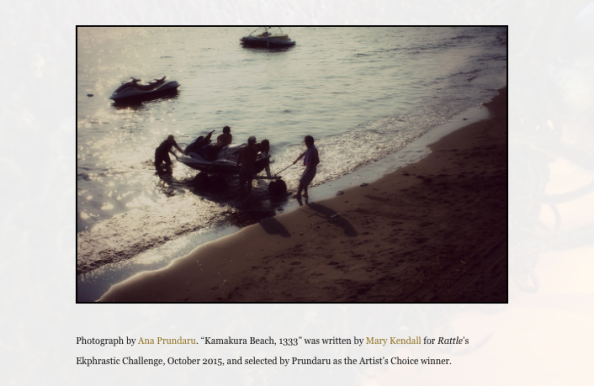




 A Poet in Time